

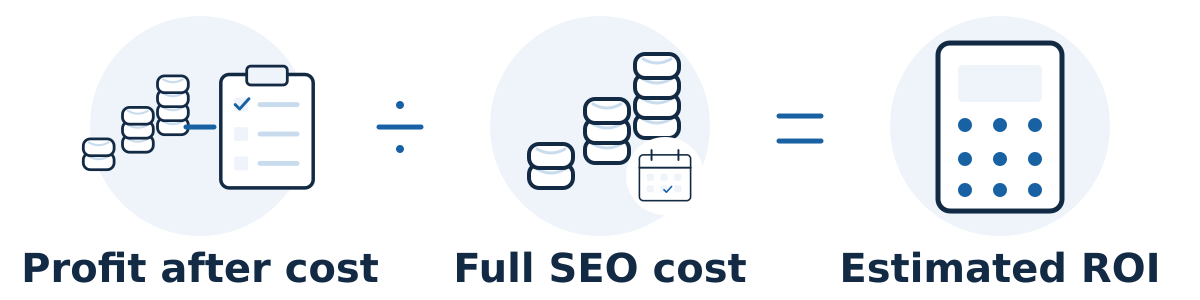
Estimate SEO return by comparing the additional profit reasonably attributable to SEO with the full cost of the work over a defined period. Rankings and traffic can help explain progress, but they are not financial return by themselves. Treat the result as an estimate when attribution or customer value is uncertain.
Choose a consistent calculation
A practical planning formula is: estimated SEO ROI equals incremental contribution profit attributed to SEO, minus SEO cost, divided by SEO cost. Multiply the result by 100 to express it as a percentage. Contribution profit here means revenue remaining after the relevant direct costs of serving those customers.
Define your cost basis before comparing periods. It may include agency fees, content production, implementation, tools, and material internal effort. Avoid changing the definition merely to make one period look better.
What does a simple example look like?
Suppose, purely as an illustration, a campaign costs $6,000 over a chosen period. The business estimates that incremental customers attributable to that work produced $10,000 in contribution profit. The calculation is $10,000 minus $6,000, divided by $6,000: approximately 67%.
If the attributable profit were only $4,000, the same calculation would be approximately negative 33%. These figures are arithmetic examples, not forecasts or SmallBizSEO client results.
How many additional customers would cover the cost?
A break-even worksheet turns the investment into a business question: how much additional customer contribution would have to be reasonably attributable to SEO to cover the full cost?
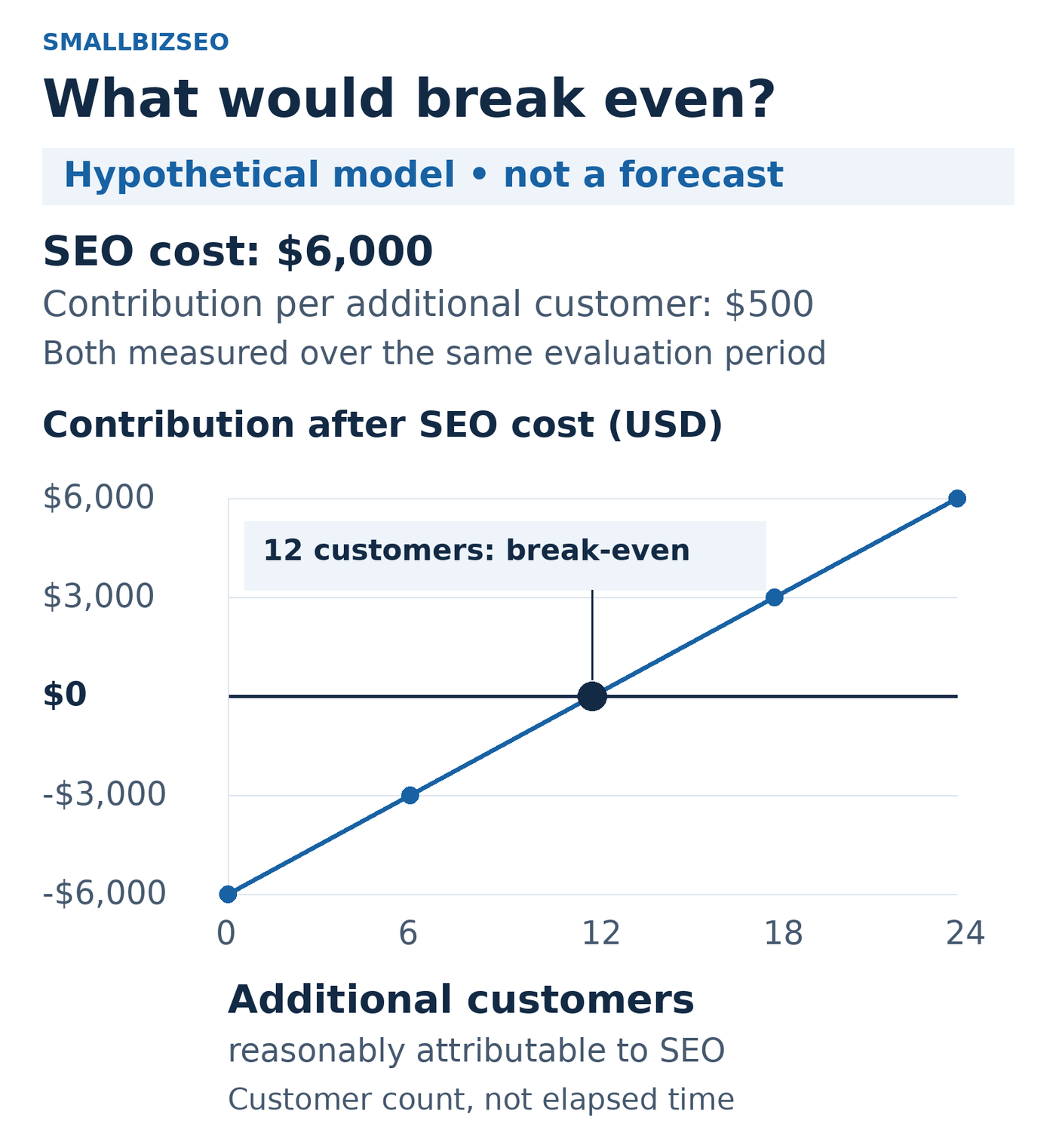
Illustrative break-even model: $6,000 SEO cost and $500 contribution per additional customer in the same evaluation period. Assumptions, not a forecast.
Additional customers | Contribution before SEO | SEO cost | After SEO cost |
|---|---|---|---|
0 | $0 | $6,000 | −$6,000 |
6 | $3,000 | $6,000 | −$3,000 |
12 | $6,000 | $6,000 | $0 |
18 | $9,000 | $6,000 | $3,000 |
24 | $12,000 | $6,000 | $6,000 |
Formula: contribution after SEO cost = additional customers × $500 − $6,000. Break-even = $6,000 ÷ $500 = 12 additional customers. Customer count is the horizontal axis, not time. The chart is a sensitivity model and does not predict future growth.
Use the same evaluation period for both costs and customer contribution. Divide total SEO cost by contribution profit per additional customer, then round up to a whole customer. Contribution profit means revenue left after the relevant direct costs of serving that customer, before deducting the SEO cost counted separately here.
Illustrative worksheet:
Total SEO cost over the evaluation period: $6,000.
Contribution profit per additional customer in that period: $500.
Break-even calculation: $6,000 divided by $500 = 12 additional customers.
At 6 additional customers: $3,000 contribution less $6,000 SEO cost = a $3,000 shortfall.
At 12 additional customers: $6,000 contribution less $6,000 SEO cost = break-even.
At 18 additional customers: $9,000 contribution less $6,000 SEO cost = $3,000 remaining after SEO cost.
At 24 additional customers: $12,000 contribution less $6,000 SEO cost = $6,000 remaining after SEO cost.
These figures are hypothetical, not SmallBizSEO client results, current package prices, a growth forecast, or an industry benchmark. The model holds contribution per customer constant only to make the arithmetic clear.
Next, estimate the qualified opportunities needed. If 20% of qualified opportunities become additional customers attributable to the work, 12 customers would require 60 qualified opportunities. At 30%, the planning figure is 40; at 40%, it is 30. These percentages are example assumptions, not recommended targets. Actual results are variable, and ordinary attributed leads do not automatically establish incremental customer growth.
Use your own records for both contribution and conversion assumptions. If the range is wide, show low, middle, and high cases rather than choosing the most optimistic one. Include implementation and other material SEO costs, allow for the time it takes to win and serve customers, and avoid putting an entire lifetime of estimated profit against one short period of spending without explaining that choice.
Your worksheet needs four entries: evaluation period, full SEO cost, contribution per additional customer, and the evidence behind your estimate of additional customers. If any entry is unknown, mark it as an assumption to investigate. Break-even arithmetic can clarify a decision; it cannot establish that SEO will produce the required customers.
Source: SmallBizSEO worked example, prepared October 14, 2026. Figures are illustrative and calculations are based solely on the stated assumptions. No external statistical claim is being made.
For the measurement workflow, see how to track calls, forms, and booked jobs from organic search.
How do I estimate value for a lead-generation business?
Count genuine, qualified inquiries rather than every form submission.
Track which inquiries become customers.
Use realistic contribution profit per customer.
Allow for the time between inquiry and purchase.
Avoid counting the same customer as a full win for several channels.
For repeat-purchase businesses, lifetime value can be useful if the underlying retention and margin data are reliable. If they are uncertain, show a conservative range rather than a single optimistic number.
What makes attribution difficult?
A customer might first discover you through search, return after a referral, and later contact you directly. Google Analytics attribution guidance explains how credit can be assigned across a customer's path. Different methods can produce different channel valuations.
Attributed sales also do not automatically prove that every sale was additional. Compare against a reasonable baseline and consider seasonality, price changes, promotions, and other marketing activity.
How should I use the estimate?
Report the period, costs, assumptions, and a plausible low-to-high range. Pair the estimate with lead quality, conversion trends, and completed work. Use it to decide what to continue, improve, or investigate. A transparent estimate that acknowledges uncertainty is more useful than a precise-looking percentage built from unsupported assumptions.