


Keywords should be chosen by how closely a search matches what you sell, who you serve, and the action you want a visitor to take. Search volume is useful context, but a popular phrase has little business value if it attracts people you cannot help.
The practical result should be a short, prioritized map of topics and pages. You should be able to see why each topic matters and where a potential customer would go next.
Start with the business, then check the search demand
List your valuable services. Include your priorities, profitable work, capacity, and the jobs you want fewer of. A service you cannot currently deliver should not lead the plan.
Collect customer language. Review questions from sales calls, emails, estimates, and your team. Customers may describe the problem differently from the name your industry gives the solution.
Separate buying questions from general research. A search for a provider, an estimate, or a service comparison usually needs different content from a definition or a do-it-yourself tutorial.
Check the results people actually see. Look at representative searches in the relevant market. Note whether the results favor service pages, product pages, directories, videos, or educational articles. This helps determine the page a searcher expects.
Assign each topic to an existing or proposed page. Related phrases can often belong together. Google can understand related wording without every variation appearing verbatim, as its SEO Starter Guide explains.
Use data without mistaking it for certainty
Search Console's performance report can show searches that already generate impressions and clicks for your website. That makes it useful for spotting relevant topics where an existing page may need attention. It does not represent every possible search your future customers could make.
Google Keyword Planner can suggest ideas and provide search estimates. Its advertising forecasts and competition measures should not be treated as predictions of organic rankings. Combine tool data with customer knowledge, page quality, and the competitive results you reviewed.
Marketplace sellers should also distinguish the search system they are targeting. Etsy's shop and listing SEO guide separates Etsy search from Google search and recommends describing products in the language shoppers would use.
A hypothetical example
Imagine a bookkeeping company that serves construction businesses but does not prepare personal tax returns. A broad term such as “tax help” could bring the wrong audience. “Bookkeeping for construction companies” and questions about job-cost reporting are more aligned with its offer. Those topics might support one focused service page and a few useful supporting articles.
A practical filter for a keyword shortlist
Use this editorial decision framework to review a proposed topic before commissioning a page. It is a planning aid, not a Google scoring system.
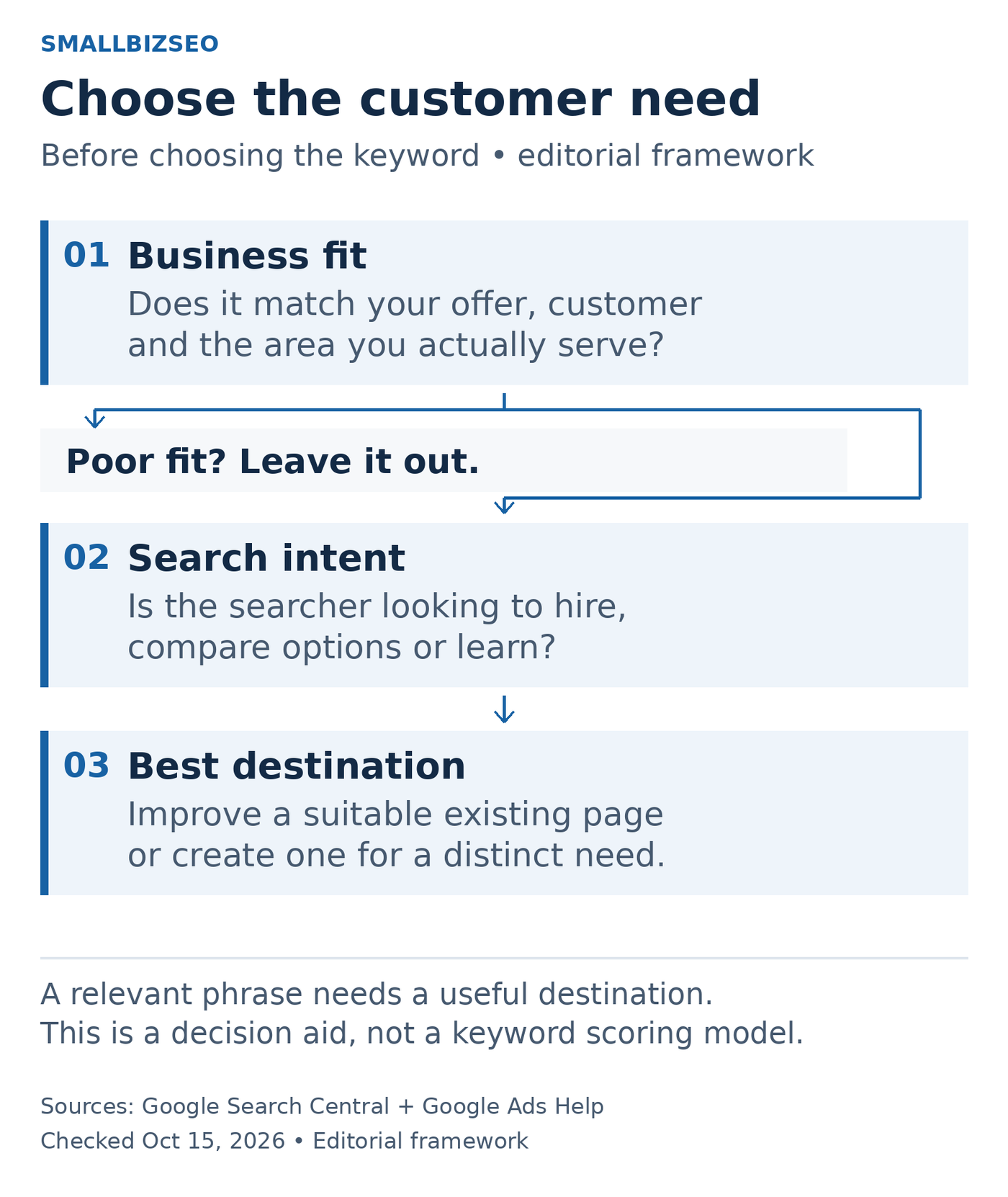
An editorial filter for choosing useful topics. No keyword score or search estimate guarantees rankings or leads.
Source: Google Search Central SEO Starter Guide and Google Ads Keyword Planner; checked October 15, 2026. The decision framework and examples are editorial.
Can we genuinely help this searcher? Write down the service, intended customer, and area served. Exclude a topic when the business cannot deliver what the wording implies. A compelling search estimate does not fix a poor fit.
What decision is the person making? Someone looking to hire needs an offer, evidence, boundaries, and a clear inquiry route. Someone comparing options needs the differences and trade-offs. Someone learning a process needs a useful explanation. Inspect actual search results to check that your proposed format fits the need.
Where should that need live? Improve an existing page when it already answers the same core need. Consider a new page when the question requires a genuinely different answer. Group natural wording variations instead of making near-identical pages. Google's SEO Starter Guide explains that its language systems can connect pages with related searches without every variation appearing verbatim.
Hypothetical shortlist for a construction bookkeeper:
“Construction bookkeeping service”: a suitable commercial topic if this is an offered service; send the searcher to the construction-bookkeeping service page.
“How does job-cost reporting work?”: a possible supporting guide; explain the process and link to the relevant service when useful.
“Personal tax return help”: exclude from this plan if the business does not offer personal tax returns.
For each retained topic, record the customer question, supporting evidence, chosen destination, and intended next action. Evidence might be an actual sales question or relevant Search Console queries. Record the source and date so an assumption can be revisited.
Treat search-volume estimates as context. Keyword Planner is an advertising research tool and may not surface very-low-volume keywords. A missing estimate is not proof that no customers need an answer. Conversely, a large estimate is not proof that a topic will produce qualified leads.
Common mistakes and the next step
Avoid approving a keyword list solely because it is long, copying every competitor topic, or creating a separate page for each small wording variation. Also avoid promising a ranking based on a keyword tool score.
Write down your three highest-priority services, ideal customers, service area, and most common sales questions. Use that information to review the proposed topic-to-page map before content production begins.