

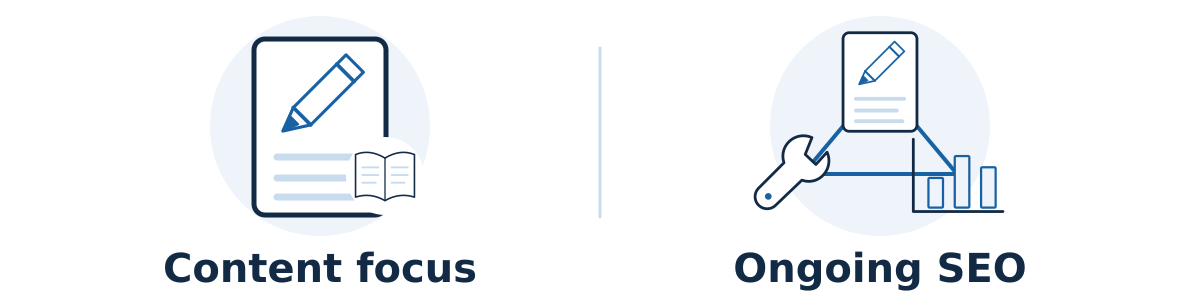
Content services are a sensible focus when the main problem is what your website says, which pages it needs, or how those pages are organized. A broader ongoing SEO program can make sense when content, technical issues, authority, and measurement all need coordinated attention. Start by identifying the constraint rather than assuming every visibility problem requires more articles.
What do SmallBizSEO's content services cover?
Our content services page describes research, planning, writing, on-page optimization, internal linking, and publishing support. It also describes working with existing website workflows, including a manual publishing handoff where direct publishing is unavailable. Confirm what is appropriate for your website before assuming a particular integration will be used.
Content work may involve a missing service page, a confusing existing page, a useful comparison, or answers to questions customers ask before purchasing. A blog is one possible format. It is not automatically the most important place to begin.
When is content the main priority?
Consider a content-focused discussion if:
Your website does not clearly explain an important service.
Prospects repeatedly ask questions the website should answer.
Existing pages are outdated, thin, or difficult to understand.
You have useful expertise or examples that are missing online.
Your team can implement and measure improvements but needs help producing the right material.
For example, a specialist contractor might have one broad services page but no useful explanation of a profitable repair offering. Improving that information could be a more relevant starting point than publishing unrelated general-interest articles. This is an illustrative scenario, not a promised result.
When is broader SEO support appropriate?
A wider scope may be useful when strong content still cannot be discovered, the website has structural problems, several teams need coordination, or the business lacks reliable measurement. SmallBizSEO's broader services also cover technical, local-search, authority, and reporting work.
If a redesign changed important URLs or search engines cannot access key pages, publishing more material may leave the underlying problem unresolved. Likewise, a business receiving inquiries from the wrong audience may need to revisit its targeting and conversion path.
What should be agreed before content production?
The reader and decision each page will support.
Whether an existing page should be improved instead of creating a new one.
The business facts, evidence, and examples needed.
Who checks accuracy and approves publication.
Who handles implementation and how results will be reviewed.
Google's people-first content guidance favors useful information for an intended audience. A publishing quota alone does not establish quality or make a page valuable.
Use the bottleneck to choose the next conversation
Before comparing service names, write down the strongest evidence of the current bottleneck. If customers repeatedly misunderstand a service and the page lacks a clear explanation, a focused content brief may be useful. If a good page cannot be reached or a form fails, identify who can resolve that implementation problem.
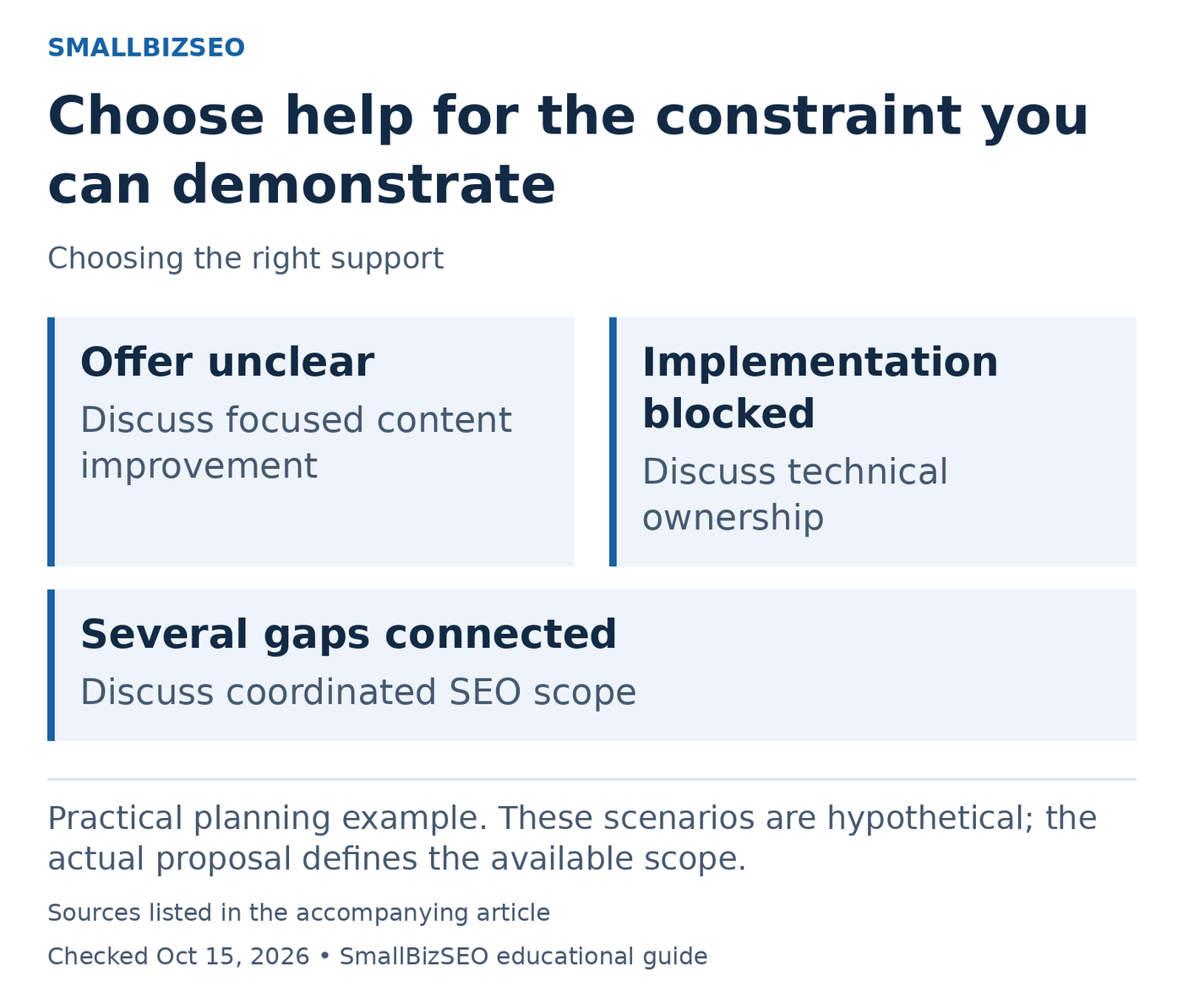
Practical planning example. These scenarios are hypothetical; the actual proposal defines the available scope.
Sources: Google people-first content guidance. Checked October 15, 2026. This visual is an editorial guide, not measured client results.
Use a two-column inventory: “Work we can reliably handle” and “Work needing outside help.” Include factual input, writing, approval, publishing, technical changes, and measurement. Being able to write a draft does not necessarily mean your team has time to maintain it; having a developer does not establish who prioritizes their SEO work.
Hypothetical example: A consultant has an accurate website and working inquiry tracking but needs an explanation of a new service. A bounded page project may fit. A retailer with unclear product information, broken navigation, and unreliable measurement needs a discussion about several connected responsibilities before choosing a writing volume.
Ask for a proposed first deliverable and the dependencies that must be completed before it creates value. Confirm the available engagement format and implementation responsibilities directly. You can use this decision aid without assuming either option contains a particular number of pages, a contract length, or a guaranteed result.
Reference: Google people-first content guidance. These scenarios are hypothetical; the actual proposal defines the available scope.
How do I choose?
List the website's main weaknesses and the work your team can already handle. Bring that to a content or SEO discussion and ask which service closes the actual gap. You can begin with a focused problem while considering how the work fits the wider website. Confirm the available engagement format, responsibilities, and scope directly rather than assuming content services carry particular contract or ownership terms.