

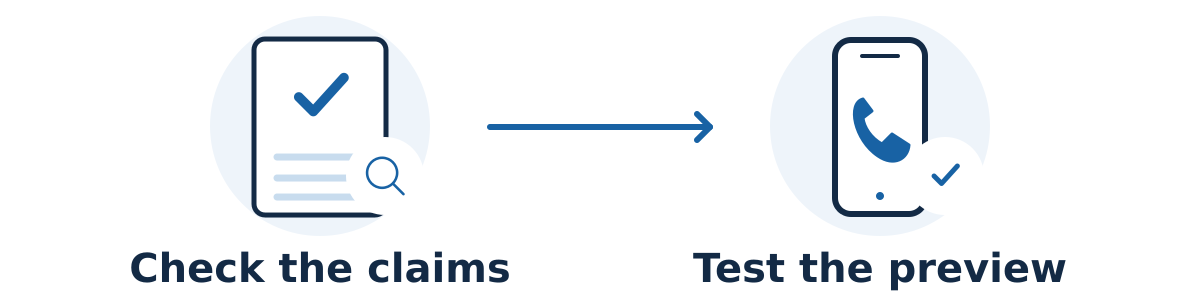
Review SEO content as the person responsible for what your business promises. Your most valuable contribution is checking whether the page accurately describes your services, answers a real customer question, and supports its claims. You do not need to turn every sentence into a keyword exercise.
Review the business facts first
Read the draft without an optimization score beside it. Check service scope, areas covered, prices if included, eligibility requirements, delivery methods, opening hours, credentials, and exclusions. Highlight anything that could cause a customer to buy with the wrong expectation.
Separate a factual correction from a preference. “We do not repair commercial boilers” is a publication blocker. “I prefer a shorter opening” is editorial feedback. This distinction helps a writer fix the important issues without guessing which comments are mandatory.
Use four review passes
Accuracy: Verify numbers, quotations, specifications, and external sources. Ask where a claim came from. Remove unsupported superlatives or promises. A statement about legal, financial, medical, or safety matters needs appropriately qualified review.
Useful detail: Ask whether a prospective customer could make a better decision after reading. Add the practical questions your team hears, such as what happens during a visit or what information is needed for a quote.
Evidence and permission: Confirm that testimonials are genuine, examples are correctly labeled, and you may publish any client names, photographs, or project details. Replace invented experience with a verified example or an explicitly hypothetical explanation.
Customer action: Check that the next step matches the page. A quote button should lead to a working quote form. Explain what the customer needs to provide and avoid implying an unapproved response-time commitment.
Google's people-first content guidance supports evaluating usefulness, accuracy, and the expertise behind a page. Its recommendations are quality questions, not a certification or a required keyword density.
A hypothetical example
A roof repair draft says the company offers “same-day repairs for every property.” The owner confirms that only inspections can sometimes happen that day, subject to availability. Correcting that sentence prevents a misleading promise. Adding what happens after the inspection is more helpful than repeating “roof repair” several extra times.
Approve the version customers will actually see
Give consolidated comments in one place and identify the final approved version. Then review the page preview on a phone: headings, links, images, contact details, and forms can change during publishing. Agree with your provider who signs off and who publishes; do not assume those responsibilities are included automatically.
A simple workflow makes those responsibilities easier to follow. Airtable's marketing-workflow guide describes a sequence from briefing and drafting through review, approval, and publishing, with clear owners and dependencies. You can use that structure in the tool your team already uses.
Approval does not guarantee ranking or remove the need for later updates. Save the evidence behind changeable claims so the next review is faster.
Separate publication blockers from editing preferences
Give each review comment a consequence as well as a suggested edit. A publication blocker is something that would materially mislead the customer, expose private information, or make an unsupported promise. A clarification helps the customer understand a real limitation or next step. A style preference improves wording without changing the underlying facts.
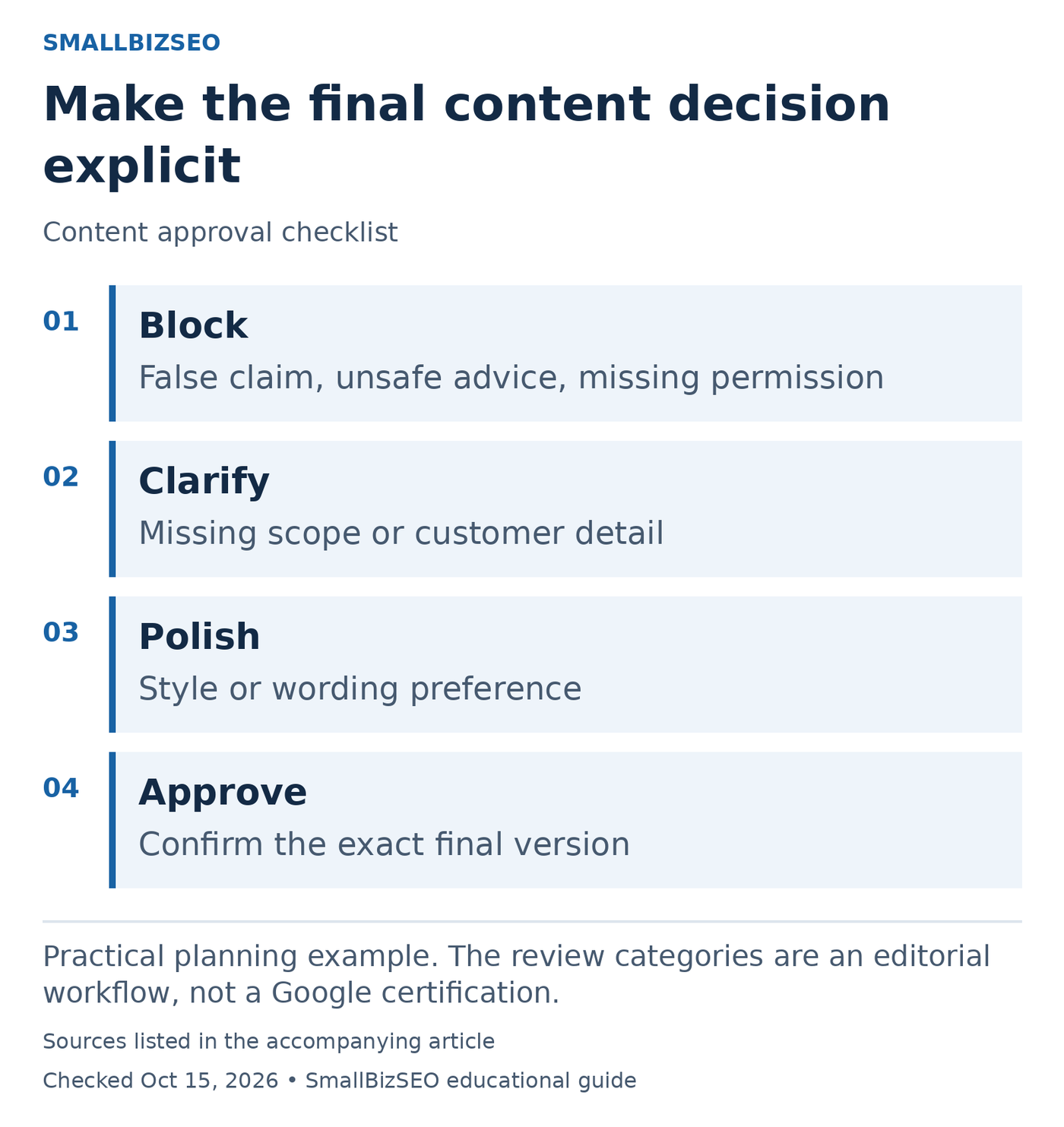
Practical planning example. The review categories are an editorial workflow, not a Google certification.
Sources: Google people-first content guidance. Checked October 15, 2026. This visual is an editorial guide, not measured client results.
Hypothetical review: A draft says “all installations include disposal,” but the owner has not confirmed disposal is included. Mark that as a blocker and ask the responsible person to verify the scope. A missing explanation of how to prepare the room is a clarification. Preferring “speak with us” to “contact us” is a wording choice.
Attach the source of a correction when possible: an approved service description, current product specification, or permission to use a project image. Keep confidential customer material out of the public draft and use an approved anonymized example where appropriate.
Before approval, check the precise final version rather than relying on an earlier draft. Record which blockers were resolved, who verified changeable facts, and whether the published preview still matches the approved offer. This classification makes feedback easier to act on without making approval a claim about future search performance.
Reference: Google people-first content guidance. The review categories are an editorial workflow, not a Google certification.
Your next step
Choose one draft and mark each comment as “factual correction,” “missing customer detail,” or “wording preference.” Return that consolidated review with a clear list of anything that must be fixed before publication.