


SEO is worth considering when potential customers search for what you sell and you can turn those searches into profitable business. Its priority depends on customer demand, your margins, your website, and how soon you need results.
Work through five business-fit questions
Are your buyers already looking for help? List the problems, services, and products that customers mention before buying. Search a few of those phrases and look at the results. Service providers, product pages, and comparison guides suggest different buying journeys. A completely new product category may also need education, partnerships, or outreach to create demand.
Which customers would make the investment worthwhile? Choose the services or products you want to grow. Include your delivery costs and realistic repeat purchases when estimating customer value. A popular search that attracts low-margin work outside your service area can be less useful than a smaller, highly relevant opportunity.
Can you serve additional demand? Check availability, staffing, stock, and lead response. If the business is fully booked, the goal might be better-fit projects rather than more inquiries. Your website should make that preference clear.
Can the website help a buyer decide? Someone arriving from search should understand what you offer, who you help, where you operate, and how to take the next step. If those basics are missing, include improving them in the investment.
Can you support a gradual learning period? SEO needs time for implementation, evaluation, and refinement. If cash flow depends on sales arriving next week, avoid making an uncertain search result your only acquisition plan.
Example: test the economics before chasing traffic
Hypothetical example: A commercial cleaning company wants more recurring office contracts. After direct delivery costs, an average new contract contributes $400 a month. A $1,200 monthly marketing investment would require the equivalent of three additional active contracts just to cover that cost, before overhead. If winning three contracts requires 15 qualified inquiries, that is a useful planning target.
These numbers are illustrative, not a forecast. Real results depend on conversion rates, retention, capacity, and how confidently new business can be attributed to marketing. The exercise helps you ask whether the proposed search opportunity could support your business goal.
When to start smaller
A focused project may be sensible if you have a clear offer but limited time or budget. Improve one valuable service page, establish a baseline, and track qualified inquiries. Google explains that Search Console can help you understand search visibility and relevant traffic; combine that information with your own inquiry and sales records.
Avoid choosing SEO simply because a competitor uses it, or because someone promises large traffic numbers. Also avoid rejecting it only because you sell to a narrow audience: a few valuable customers can matter more than broad reach.
A small feasibility brief for an SEO decision
Before choosing a campaign, complete a brief that makes the commercial assumptions visible. It should be short enough for an owner, salesperson, and website specialist to review together. The purpose is to identify uncertainty before it turns into a recurring expense.
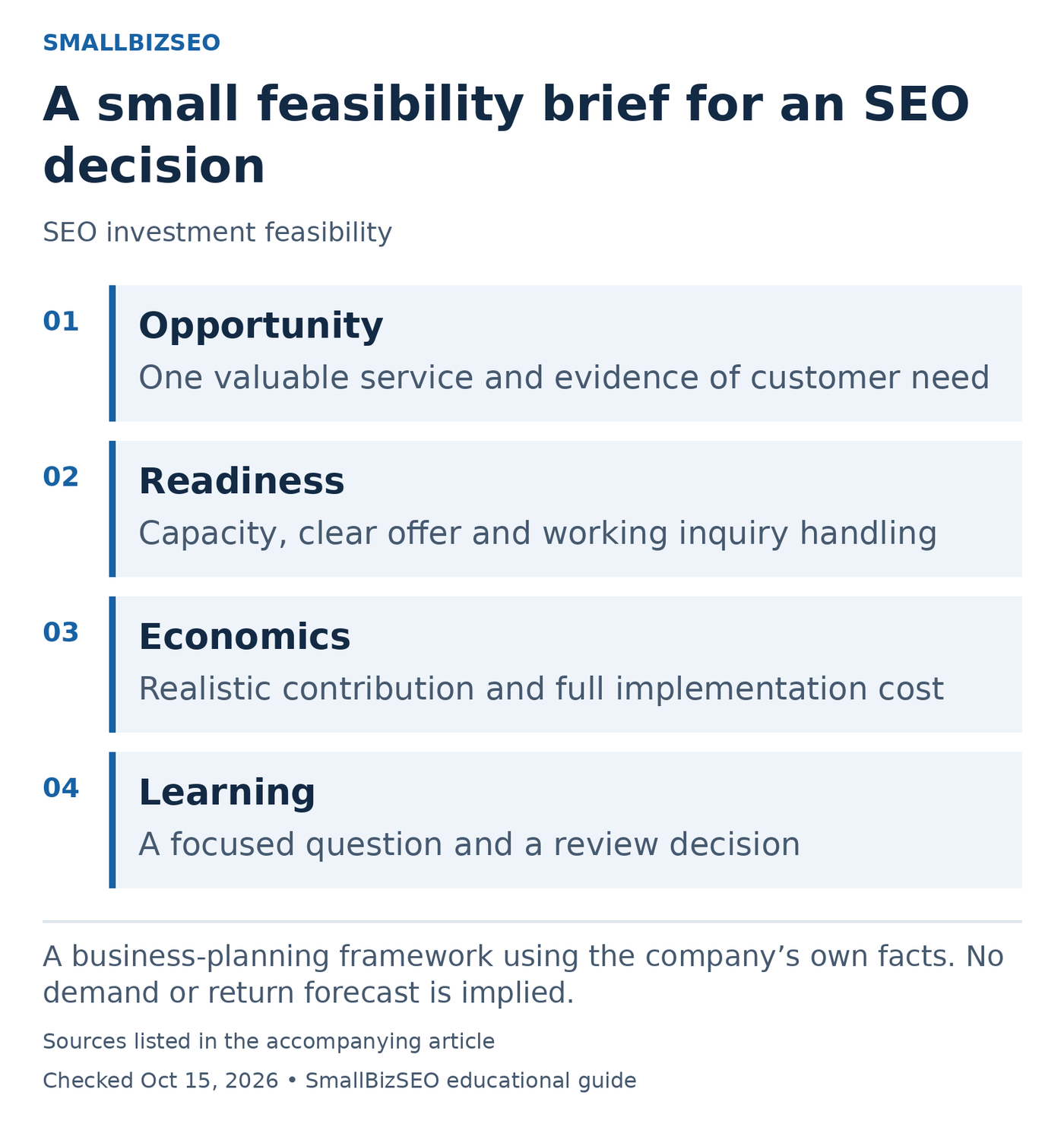
A business-planning framework using the company’s own facts. No demand or return forecast is implied.
Sources: Google official guidance. Checked October 15, 2026. This visual is an editorial guide, not measured client results.
Opportunity: name one service and the customers you want more of. Write down the questions those customers ask and where you have seen evidence of demand. Mark a guess as a guess. A competitor’s prominent website is a clue to investigate, not proof of your available market.
Readiness: check capacity, contact handling, and the page that would receive visitors. If the service is temporarily unavailable, the useful first project may be correcting the offer and inquiry expectations. Additional traffic cannot solve a capacity mismatch.
Economics: use your own contribution and sales information to decide what a suitable new customer could support. Keep uncertain repeat business separate from revenue already likely to occur. Include implementation and staff time when comparing the effort with alternatives.
Learning plan: choose the first question a focused project could answer and the evidence you will review. A hypothetical specialist repair business might begin by clarifying its one valuable service and recording suitable inquiries. Continue, revise, or pause based on what is learned and what the business can afford. This is a decision process, not a forecast of leads or a universal recommendation to buy ongoing SEO.
Reference: Google’s official guidance. This checklist is an editorial planning aid; checked October 15, 2026.
Your next step
Write down one customer type, one profitable offer, your available capacity, and the business result you want. Use that short brief to decide whether an SEO assessment is a useful next investment.