


Plan seasonal SEO around when customers start researching and booking, not only when you deliver the service. Work backward from that decision window to allow time for content, approvals, implementation, and testing. Keep useful recurring pages available between seasons, with accurate availability and a clear next step. There is no universal launch date that guarantees search visibility by a holiday or busy period.
Plan backward from seasonal demand
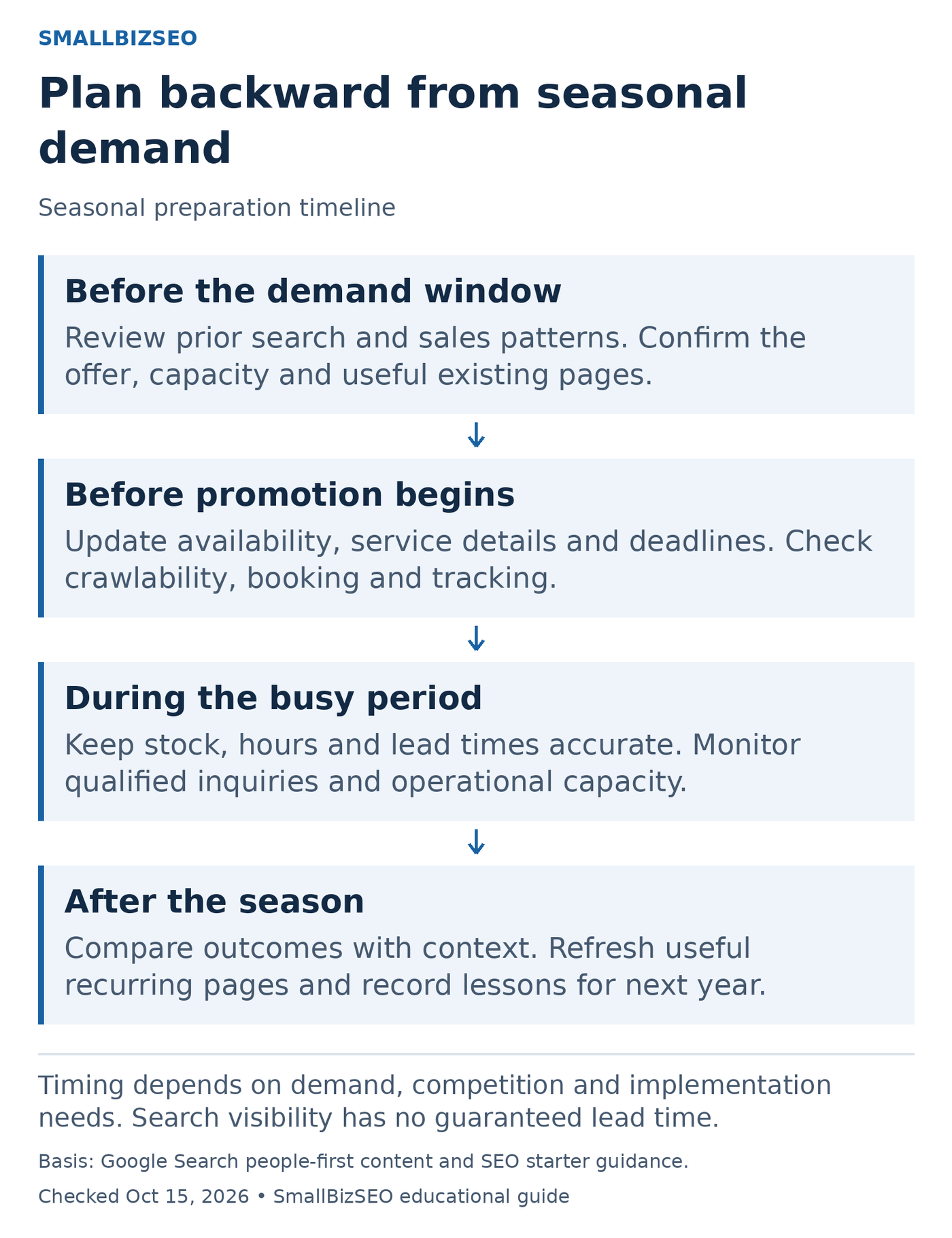
An editorial reverse-planning timeline. Start from the real buying window and operational deadlines, rather than a universal SEO timetable.
Before the demand window: Review prior search and sales patterns. Confirm the offer, capacity and useful existing pages.
Before promotion begins: Update availability, service details and deadlines. Check crawlability, booking and tracking.
During the busy period: Keep stock, hours and lead times accurate. Monitor qualified inquiries and operational capacity.
After the season: Compare outcomes with context. Refresh useful recurring pages and record lessons for next year.
Timing depends on demand, competition and implementation needs. Search visibility has no guaranteed lead time.
Diagram references: Google guidance 1 · Google guidance 2. Checked October 15, 2026.
Find the decision window
Start with your own inquiry dates, bookings, completed jobs, and sales records. A customer may reserve an event service months before the event, while an urgent weather-related repair has a much shorter window. Separate research demand, booking demand, and delivery demand instead of treating the busiest operational month as the whole marketing calendar.
Compare more than one season where records allow. Note changes in capacity, prices, opening hours, weather, and promotions that could explain differences. A new business can use customer conversations and broader demand research as starting evidence, but should label its initial calendar as an assumption to test.
Google Trends can help reveal relative timing. Its scores are normalized, not absolute search counts; a value of 100 does not mean 100 potential customers. Keep location, term selection, and time range consistent when comparing patterns, and do not interpret insufficient data as proof that nobody needs your service.
Build backward from the booking deadline
Choose the date by which a customer needs to find a useful, working page. Before that, allow time to confirm the offer, gather project evidence, write or update content, obtain approval, and test the inquiry route. Include whoever controls scheduling and capacity, because a page promoting unavailable appointments creates work without creating a useful sale.
For planning purposes, a business might start its review several months before the expected research window. That is an editorial planning choice, not a Google requirement or a promise that SEO takes a fixed number of weeks. An established page with accurate information may need a light refresh; an entirely new service can require a larger body of work.
Do not leave all publication until the week demand peaks. If the deadline is too close, prioritize the existing page and contact route. Other marketing channels may support immediate demand, but they need their own budget and plan.
Keep recurring pages useful
For a service that returns each year, consider maintaining one stable service URL and updating the meaningful details. Avoid creating nearly identical annual pages simply to change a year in the title. A genuinely date-specific event or archived resource may deserve a separate page when customers need that history.
During the off-season, explain whether inquiries, advance bookings, or waiting-list requests are open. Remove expired claims and offers. If next season's dates are unconfirmed, say so instead of leaving last year's schedule looking current. Google cautions against changing dates solely to create an impression of freshness in its people-first content guidance.
Keep business hours accurate too. Google's business representation guidance covers seasonal opening and temporary closure. A seasonal service offered by a year-round business does not automatically mean the whole business is closed.
A hypothetical seasonal plan
A holiday-light installer wants customers to book before installation slots fill. The owner reviews previous inquiry dates and discovers that people ask about estimates well before installation begins. The team updates its existing service page ahead of that research period, adding current scope, booking steps, and approved project photographs.
When installation capacity fills, the page changes its next step to the actual remaining options rather than continuing to promise open slots. After the season, the owner records which inquiries were suitable, what customers misunderstood, and which scheduling questions should be answered next year. No traffic or revenue increase is assumed.
Your seasonal planning checklist
Identify research, booking, and delivery periods separately.
Check historical demand and record uncertainties or unusual circumstances.
Confirm offer, capacity, deadlines, and responsibility for updates.
Choose the existing page to improve or justify a distinct new page.
Work backward through drafting, approval, publishing, and testing dates.
Update availability during the season and remove expired promises afterward.
Review qualified inquiries and bookings against a comparable prior period.
Measure with the season in mind
A quieter month after peak demand is not automatically an SEO failure. Compare equivalent stages of the season and investigate whether demand, visibility, conversion, or capacity changed. Keep a record of publication dates and business changes so those explanations remain visible.
Your first deliverable should be a one-page calendar linking customer decisions to specific website tasks. The purpose is to arrive prepared and learn from the season, not to promise that search rankings will follow your business calendar.