


Update website content when the facts, your offer, or the reader's needs change. Set review reminders for important pages, but do not rewrite accurate content just to make it look recent. The right schedule depends on how quickly the information becomes outdated and what happens if a customer relies on it.
Use change triggers and review reminders together
Some edits should happen as soon as the underlying change takes effect: a new phone number, revised service area, discontinued product, changed opening hours, or an expired promotion. Waiting for a quarterly content review could mislead people who are ready to buy now.
Other content benefits from a periodic check. As a practical starting point, review high-value service and product pages every quarter, and stable educational guides every six to twelve months. These are planning suggestions, not Google requirements. Increase the frequency for fast-changing subjects or pages your customers rely on heavily.
Ask four questions during a review
Is it still accurate? Verify the offer, claims, examples, links, contact information, and sources. Confirm that the business can still deliver what the page describes.
Is something important missing? Add a recurring customer question, a useful explanation, or new evidence when it improves the decision the page supports.
Does the page still have a clear purpose? Watch for accumulated sections that distract from the main task. An update may involve simplifying or combining information.
Has performance changed in a meaningful way? Compare relevant periods and check which queries and pages changed. A seasonal dip or broken tracking does not automatically mean the writing needs replacement.
Search Console can show page and query trends. Combine those observations with inquiry quality and feedback from your team before choosing a rewrite.
A hypothetical example
A cleaning company stops offering one-off deep cleans and focuses on recurring contracts. Its service pages, quote options, and supporting articles need prompt corrections. An older guide explaining how to prepare for a cleaner may still be accurate. It can remain in place after review without an artificial rewrite.
Make dates meaningful
Google warns against changing dates to imply freshness when the content has not substantially changed. Adding or removing lots of content simply to make the whole site look fresh is also not a sound strategy. See its content guidance. Use an updated date when it genuinely helps readers understand a meaningful revision.
Keep a short change record: what changed, why, who verified it, and when to check again. That makes maintenance manageable and helps explain performance changes later. Even a well-supported update cannot guarantee more traffic.
Match the review trigger to the cost of being wrong
Use a maintenance record with four fields: page, change trigger, responsible person, and evidence checked. The trigger should describe a real event, such as a discontinued service, revised opening hours, or a recurring question the page does not answer.
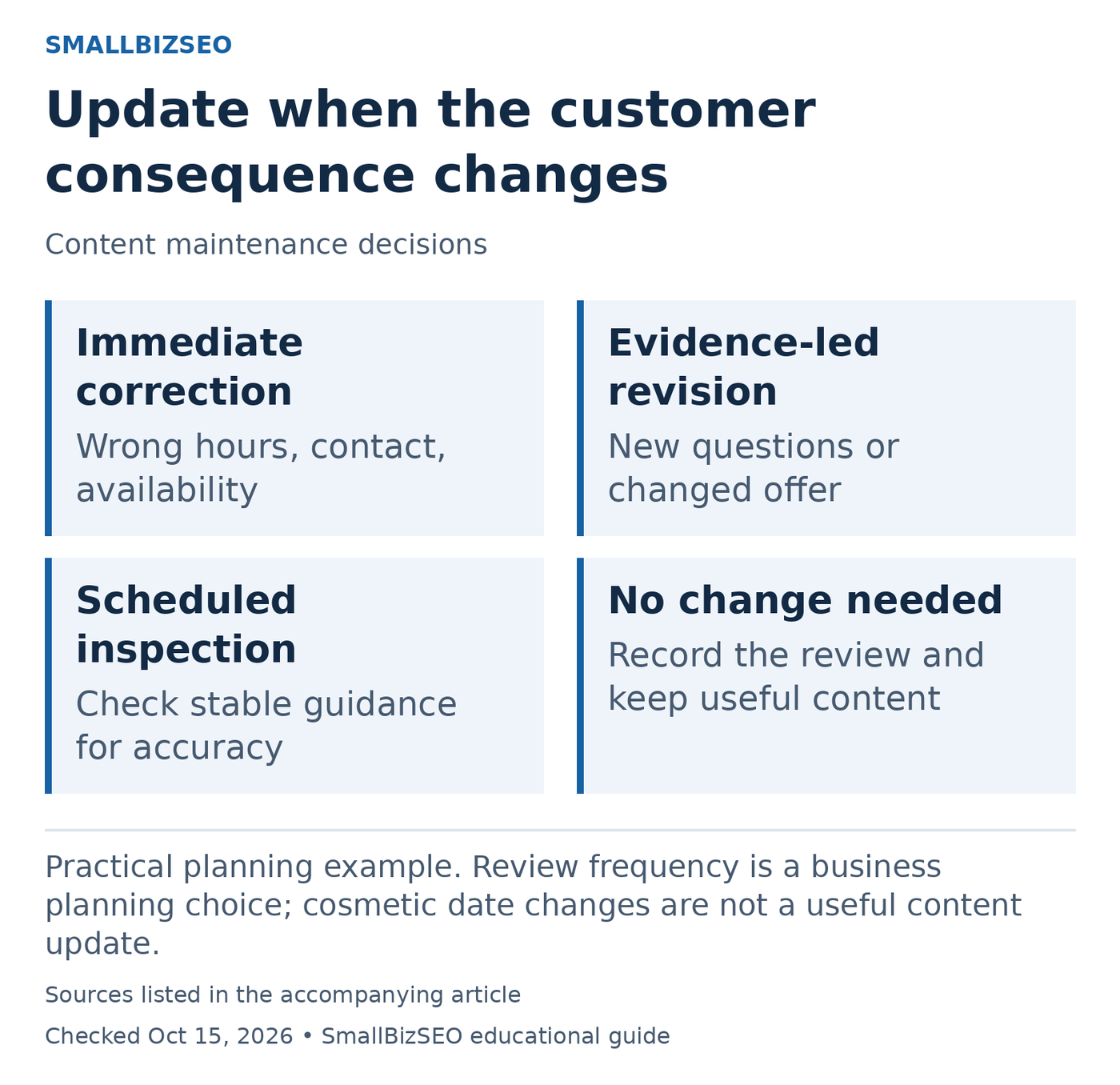
Practical planning example. Review frequency is a business planning choice; cosmetic date changes are not a useful content update.
Sources: Google people-first content guidance. Checked October 15, 2026. This visual is an editorial guide, not measured client results.
Prioritize by the customer consequence of outdated information. Incorrect booking instructions can waste a visit or lose an inquiry. A stable explanation of a routine process may remain useful after an accuracy check. Both deserve an owner, but they do not need identical editing schedules.
Hypothetical example: A repair company changes the products it accepts. The booking page and service descriptions need correction when that change takes effect. A general maintenance guide may need only a check for references to the discontinued service. Record which pages changed and which were reviewed but remained accurate.
For each meaningful revision, save what changed and who confirmed it. When no change is needed, keep that review note internally rather than inventing a visible update. If search performance falls, check the evidence before rewriting: an inaccurate page is one possible issue, while demand, measurement, or technical changes can require a different response. The maintenance record helps separate those questions.
Reference: Google people-first content guidance. Review frequency is a business planning choice; cosmetic date changes are not a useful content update.
Your next step
Choose your five most important customer-facing pages and give each a review owner, next review date, and list of business changes that should trigger an earlier update.