


Choose an SEO company that can explain what it would improve, why those changes matter to your business, and how you will evaluate the work. A polished sales presentation is less useful than a clear, credible plan you can question.
Review a proposal in six steps
Give every provider the same business brief. Share your priority services, target customers, service area, capacity, and desired outcome. Comparable inputs make proposals easier to assess. If one proposal aims to sell a particular service and another promises general traffic growth, they are solving different problems.
Ask what happens first and why. A useful answer identifies an initial area to investigate, what evidence is needed, and the dependency before implementation. Be cautious if a full campaign is prescribed before anyone understands the website or your business constraints.
Examine evidence in context. For a case study, ask what work was done, what the starting point was, and whether the reported improvement involved relevant inquiries or customers. A percentage gain is hard to interpret without the original numbers. Another client's result is evidence of experience, not your forecast.
Separate recommendations from completed work. Confirm whether the fee covers research, writing, website changes, developer time, reporting, or only advice. Ask who approves and implements each task. A lower quote may leave substantial work with your team.
Agree on reporting and communication. Request a sample report and an explanation in plain language. You should be able to identify what changed, whether useful demand increased, what remains uncertain, and what happens next.
Clarify ownership and the exit process. Ask who controls the domain, website, content, and reporting accounts; what you receive when work ends; and how any outstanding work is handled. Review the actual proposal or agreement rather than assuming these details are standard.
Protect access during evaluation
An early review does not usually require handing over every administrator account. Start with the minimum access needed and increase it only for agreed work. Search Console provides different permission levels, so access should match the task. Avoid sending your main login password in an ordinary email.
Example: compare the same outcome
Hypothetical example: A landscaping company receives one proposal for a fixed number of blog posts and another for improving its garden-design service pages, inquiry tracking, and supporting customer questions. The second is not automatically better. The owner should ask both providers to connect their proposed work to suitable garden-design inquiries and explain who will implement it.
If a provider cannot make that connection, the deliverable count alone is a weak basis for the decision.
Warning signs
Pause when someone guarantees a top ranking, will not describe their methods, or cannot distinguish advertising results from organic results. Google's hiring guidance warns against ranking guarantees.
Also avoid choosing solely on the cheapest monthly price, a proprietary score, or the number of keywords listed. Ask what useful change the budget will actually buy.
Compare proposals with the same evidence sheet
Give each shortlisted provider the same questions and record the answer in its own words. Use “clear,” “needs clarification,” or “not included” rather than an invented numerical score. The goal is to reveal differences you would otherwise discover after signing.
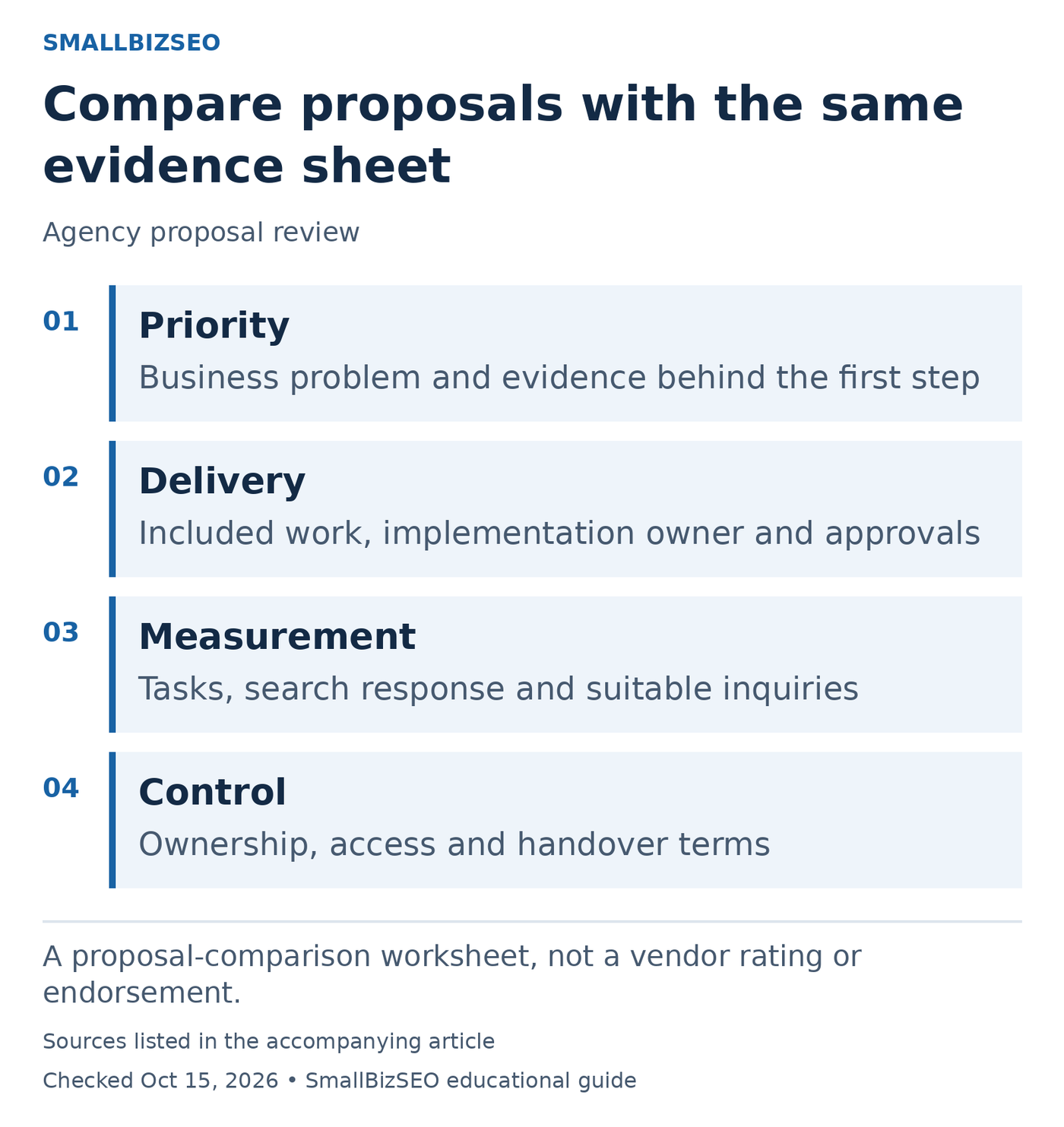
A proposal-comparison worksheet, not a vendor rating or endorsement.
Sources: Google official guidance. Checked October 15, 2026. This visual is an editorial guide, not measured client results.
Priority and reason: what customer problem or website limitation will be investigated first, and what evidence supports that choice? A confident recommendation is not a substitute for understanding your offer, available capacity, and current website.
Delivery boundary: which tasks are included, which require a developer or your staff, and who approves publication? Ask for one example deliverable. Two equal monthly prices may buy quite different amounts of implemented work.
Measurement: what would the report show if rankings changed but no suitable inquiries arrived? Ask how the provider separates completed tasks, search response, and business outcomes. Request context for case studies instead of treating another company’s percentage increase as your likely result.
Control and handover: who owns the accounts and produced materials, how is access granted, and what happens to unfinished work when the engagement ends? Read the actual agreement for these terms.
End with the unresolved questions rather than a winner selected by keyword count. A hypothetical proposal may look less expensive because it supplies advice while your team must implement everything. That can still be appropriate when you have capacity. It becomes a problem when nobody knows the work is theirs. Ask for the missing detail before comparing value.
Reference: Google’s official guidance. This checklist is an editorial planning aid; checked October 15, 2026.
Your next step
Shortlist providers against the same brief and ask each to explain its first priorities, implementation responsibilities, evidence of success, and handover arrangements in writing.