


Prepare a short picture of your business goals, ideal customers, website, and current results. You do not need a technical SEO audit before the conversation, and missing information can become part of the discovery work.
Gather six useful things
Your desired business outcome. Name the services or products you want to grow and the kind of customer you want more of. Include location, project size, or other important fit criteria. Explain whether you need more inquiries, better-quality work, increased online sales, or support for a new offer.
Your practical constraints. Bring a realistic budget range, implementation capacity, important deadlines, and availability to serve customers. Note seasonal changes and anything that affects how quickly you can approve or publish work. These details help prevent a plan that your team cannot execute.
Your website and account inventory. Have the website address, platform name if known, hosting contact, and names of people who manage it. Note whether the business has access to Search Console, website analytics, and any relevant Business Profile. An access inventory is enough to begin; do not compile passwords into a document.
Existing evidence of demand and results. Gather a recent summary of inquiries, suitable leads, sales, and their sources where known. If available, bring useful search and website reports. Label estimates honestly. A small, accurate sample is more useful than a large export nobody can interpret.
Your customers' questions and your strongest proof. List common objections, buying questions, and reasons customers choose you. Note relevant project examples, approved testimonials, product information, and staff expertise that can support accurate content.
Important history and comparisons. Mention website launches, redesigns, URL changes, previous SEO work, major traffic changes, and current advertising. Bring a few relevant competitors and explain why you consider them comparable. Their customer base or service scope matters more than simply appearing above you once.
Example: turn a vague goal into a useful brief
Hypothetical example: An independent commercial photographer could say, “We want more repeat product-photography clients, can take two additional projects a month, and mostly receive inquiries for low-budget one-off shoots. Our product page is short, and we do not know which inquiries came from search.”
That brief immediately raises useful questions about customer fit, the service page, and measurement. “We want to rank higher” provides less direction about what success would mean.
Share information proportionately
Use aggregate figures or anonymized examples where possible. Avoid including customer records, payment details, or confidential project material unless there is a clear, agreed need and an appropriate way to share them.
If account access becomes necessary, confirm the recipient and task first. Search Console has different permission levels; choose access appropriate to the review rather than automatically granting ownership. Keep the business in control of its accounts.
Questions worth taking into the conversation
What would you investigate first, and what information is missing?
Which changes would most directly support our business goal?
Who would write, approve, implement, and check the work?
What evidence would we review before expanding the investment?
A five-line brief you can complete without perfect data
Use this fill-in structure to turn preparation into a short decision brief. First, write: “We want more inquiries for [service] from [customer type] in [market].” Second, add: “We can currently deliver [capacity or availability], and we want fewer requests for [poor-fit work].” Use plain descriptions if you do not have reliable numbers.
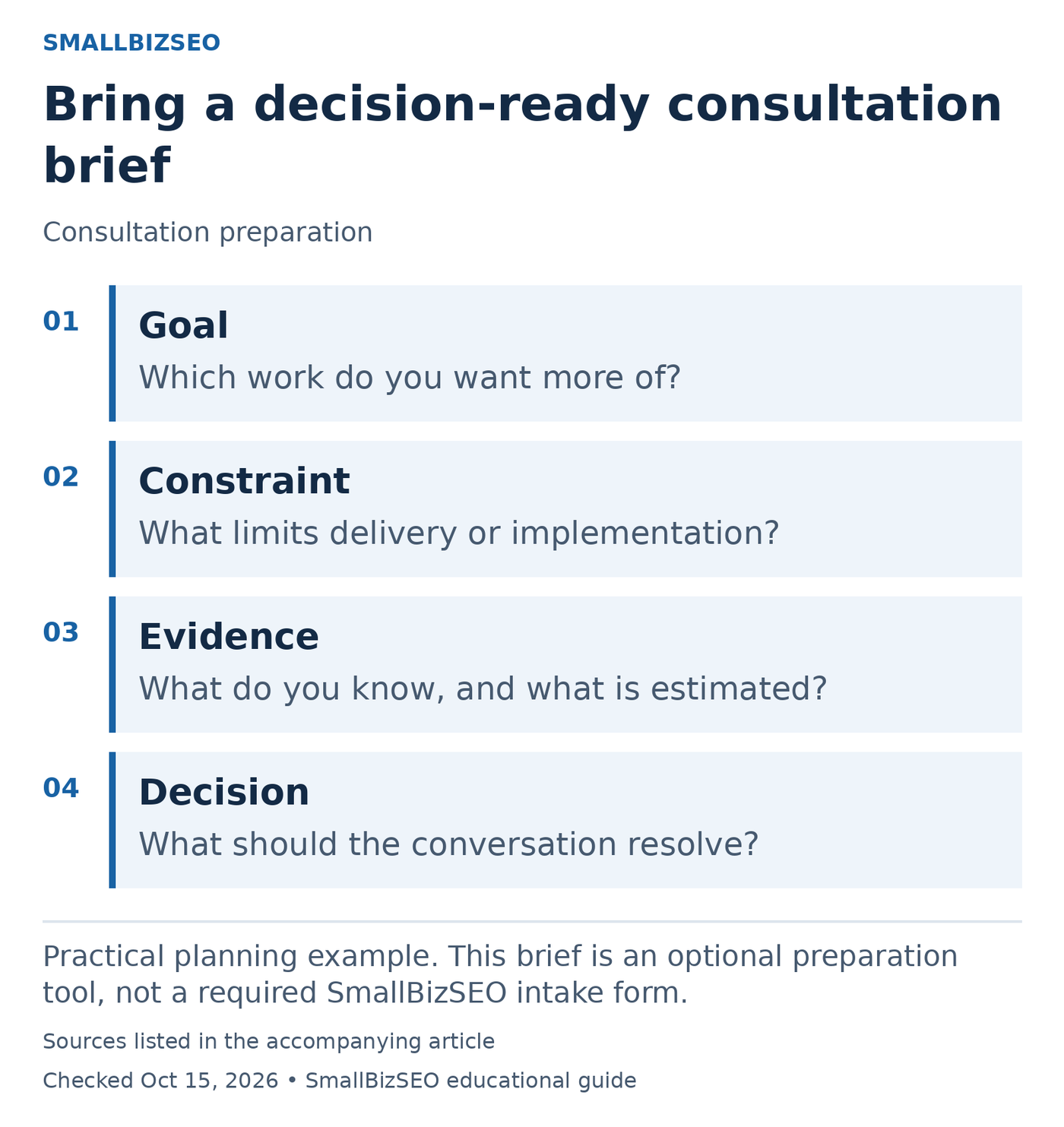
Practical planning example. This brief is an optional preparation tool, not a required SmallBizSEO intake form.
Sources: Google guidance on choosing an SEO. Checked October 15, 2026. This visual is an editorial guide, not measured client results.
Third, summarize the current evidence: “We received [known inquiry pattern]; the source is [record or report]; we do not yet know [missing detail].” Distinguish a measured figure from an owner’s impression. An unanswered question is useful information when clearly labeled.
Fourth, name the implementation constraint: “Website changes are handled by [role]; content is approved by [role]; the main practical limitation is [time, access, platform, or budget].” Identify people by role in a shareable brief unless names are needed.
Finally, write the decision you want help making: whether to repair a problem, improve an existing offer page, or investigate demand before expanding. This helps a consultation end with a specific next step. Bring aggregate evidence and approved examples; leave customer identities and credentials out of the preparation sheet.
Reference: Google guidance on choosing an SEO. This brief is an optional preparation tool, not a required SmallBizSEO intake form.
Your next step
Put the essentials on one page and attach only the reports that help explain your situation. Bring unanswered questions too; preparation should make the consultation more focused, not delay it until your data is perfect.