


You can handle many SEO basics yourself if you have time, access to your website, and a willingness to learn. Hire help when specialist problems, limited capacity, or the cost of mistakes outweigh the savings from doing everything internally.
Google notes that small local businesses can often do much of the work themselves. The useful question is which responsibilities you can carry out consistently and safely.
If you run an online store, Shopify's SEO marketing guide offers an ecommerce-oriented introduction to content, technical work, and measurement. Use it for practical context, and check platform rules and Google requirements against their official documentation.
Decide who should own each part
Keep your business expertise involved. You know which jobs are profitable, what customers ask, and why someone chooses your business. You can collect common questions, explain your process, gather approved project examples, and check that website claims are accurate. Outside help still needs this input.
Learn a manageable set of website tasks. If your website editor is straightforward, you may be able to improve service descriptions, page titles, headings, internal links, and contact details. Start with one important page. Preview it on a phone and check that forms and links work after changes.
Identify work with a larger failure cost. Moving a website, changing many URLs, resolving complex indexing problems, or modifying custom code can affect important pages at once. Get experienced help when you cannot explain the change, its risks, and how to reverse it.
Calculate the time tradeoff. Include learning, implementation, checking, and reporting. If SEO repeatedly displaces paid work or customer service, a focused external project may be better value than an unfinished internal plan.
A shared approach can work well
You do not have to choose between doing everything and handing everything over. A specialist could diagnose a problem or set priorities while your team supplies expertise and maintains content. Alternatively, you might handle business information and customer questions while an experienced developer implements technical changes.
Write down ownership before starting. Who drafts? Who approves? Who publishes? Who tests contact forms? Who reports whether inquiries were suitable? Clear responsibilities prevent completed recommendations from sitting in a document without anyone acting on them.
Example: protect the owner's time
Hypothetical example: A small upholstery shop has a simple website and an owner who can explain restoration work clearly. The owner could improve a service page using real project photos and answers to common questions. If a platform migration is planned, the business could hire help for URL mapping and launch checks instead of trying to learn that higher-risk work during the move.
This division preserves the shop's expertise and directs outside spending toward a specific need. It also gives the owner a concrete deliverable to review.
Pitfalls to avoid
Installing an SEO plugin does not complete the work. Avoid applying every automated recommendation without understanding it, making many changes at once, or buying shortcuts because the learning curve feels frustrating.
If you hire someone, keep the business in control of its domain, website, and reporting accounts. Use individual access appropriate to the task rather than sharing your main password. Agree on approvals and keep a record of important changes.
Delegate by risk and available time
Choose responsibility task by task. Start with what happens if a change is wrong, how easily it can be reversed, and whether the person doing it can check the result. This is more useful than assuming every content task is easy or every technical task needs an agency.
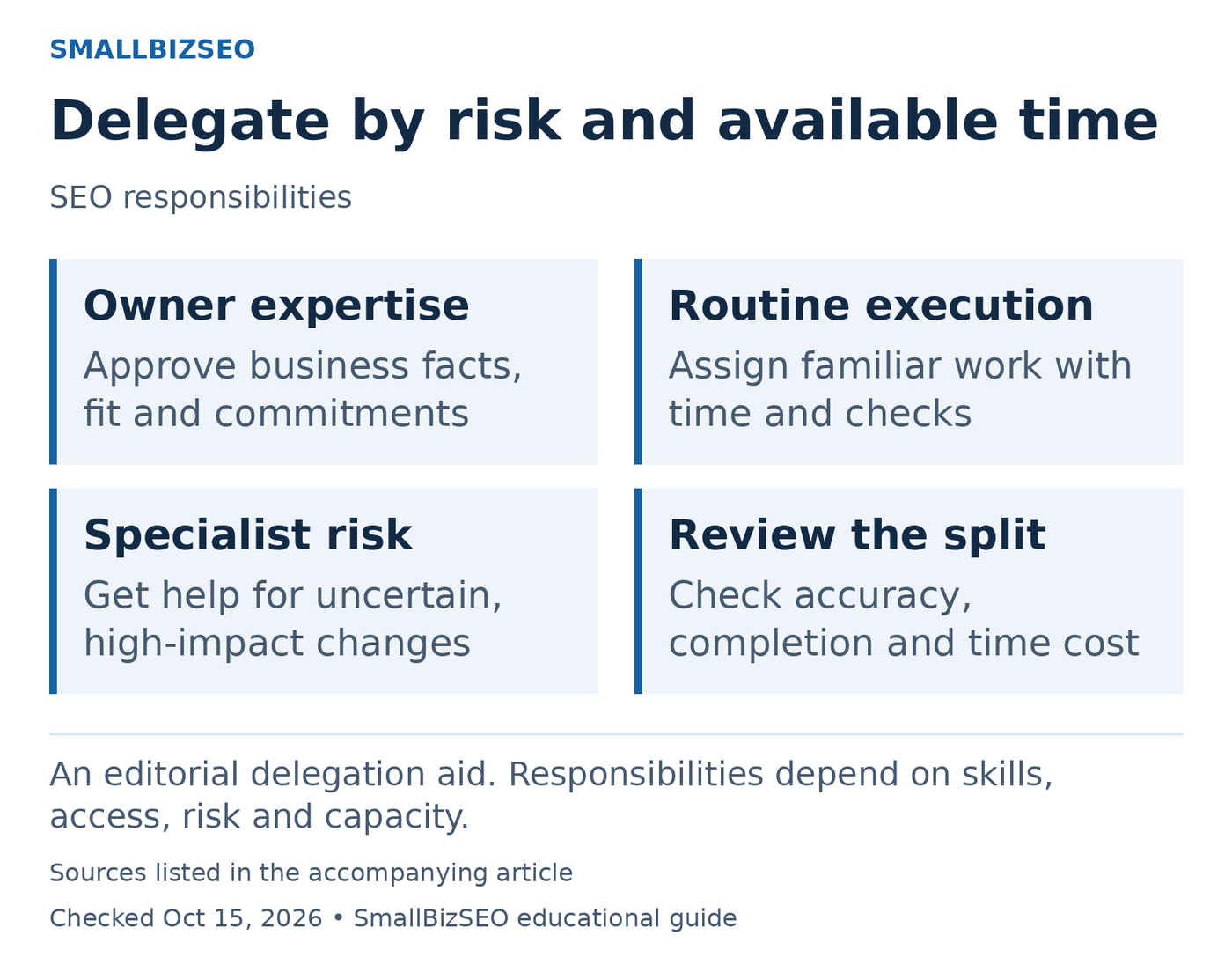
An editorial delegation aid. Responsibilities depend on skills, access, risk and capacity.
Sources: Google official guidance. Checked October 15, 2026. This visual is an editorial guide, not measured client results.
Keep business judgments close: the business should approve service scope, customer fit, prices, credentials, and promises. A specialist can improve the presentation, but cannot safely invent the facts. Gather actual customer questions and approved examples before handing over a writing brief.
Keep manageable work in-house: a trained team member may maintain contact details, review content, or make familiar editor changes. Give the work a realistic time allowance and a short test checklist. If it repeatedly gets postponed, the apparent saving may be hiding an implementation bottleneck.
Bring in specialist help for uncertainty with a large failure cost: changing shared templates, moving URLs, or diagnosing unexplained indexing behavior may warrant a defined technical project. Ask for an explanation, testing approach, and recovery option before the change.
For a hypothetical small studio, the owner could supply service expertise, a writer could organize the page, and the website manager could publish and test it. Name one approver so drafts do not circulate indefinitely. Review the arrangement after the first completed task: was it accurate, implemented, and checked without displacing essential customer work? Adjust the split based on that experience.
Reference: Google’s official guidance. This checklist is an editorial planning aid; checked October 15, 2026.
Your next step
Make two lists: tasks you can confidently maintain and tasks where you need diagnosis or implementation help. Ask for help against that defined gap rather than purchasing an unclear bundle of activity.