


No SEO provider can reliably guarantee first place in Google's organic results. Google explicitly says that no one can guarantee a number-one ranking.
A provider can control its research, recommendations, implementation, and communication. It cannot control every competing website, every searcher's situation, or Google's assessment of a page. Treat promises of a fixed position with particular caution when they drive a purchase decision.
Why the promise is often less useful than it sounds
First place needs a definition: for which search, in which market, on what kind of result, and measured how? An ad position, a map listing, and an organic webpage are different placements. A business may also appear prominently for its own unusual name without reaching many new buyers.
Google explains that ranking uses multiple systems and signals. A screenshot of one search is therefore limited evidence. Even a genuine improvement for a relevant query does not automatically mean qualified inquiries or revenue improved.
Check a guarantee before paying
Ask for the exact claim. Request the search phrases, target market, result type, measurement method, and conditions. Do not rely on a headline that promises visibility while the detailed wording measures something else.
Check the searches against your customers. Would someone using those phrases plausibly need your service, meet your requirements, and buy from you? Ask your sales or customer-service team whether the wording resembles real customer questions.
Understand the proposed methods. Ask what changes will be made to your website and how any links or outside placements will be obtained. Avoid accepting hidden methods simply because the provider attaches a refund promise.
Read what happens if the promise is missed. A stated refund, credit, or extended service period is a commercial term to review. It does not demonstrate that the underlying ranking outcome is controllable.
Example: a ranking that adds little business value
Hypothetical example: A consultant promises a cabinet maker first place for a phrase containing the company name and an unusual product description. The business achieves that position, but its ideal customers search for custom kitchen cabinets in the area. The promised ranking may have little connection to the orders the owner wanted.
The better discussion starts with a valuable service and a customer need, then checks whether the website attracts suitable prospects and helps them inquire.
What useful commitments look like
Ask for clearly defined work, responsible owners, approval steps, reporting dates, and explanations when evidence changes the plan. A provider should be able to say which outcomes it is aiming for and which assumptions remain uncertain.
Method matters as well. Google's spam policies identify practices that can reduce or remove search visibility. A ranking promise is poor compensation for work that exposes your business to avoidable risk.
Translate a ranking promise into testable questions
Write the promise down exactly, then separate the claimed outcome from the provider’s actual obligations. This helps reveal whether two people are discussing the same thing. A headline about “first place” may conceal a narrow phrase, a different result type, or conditions that matter commercially.
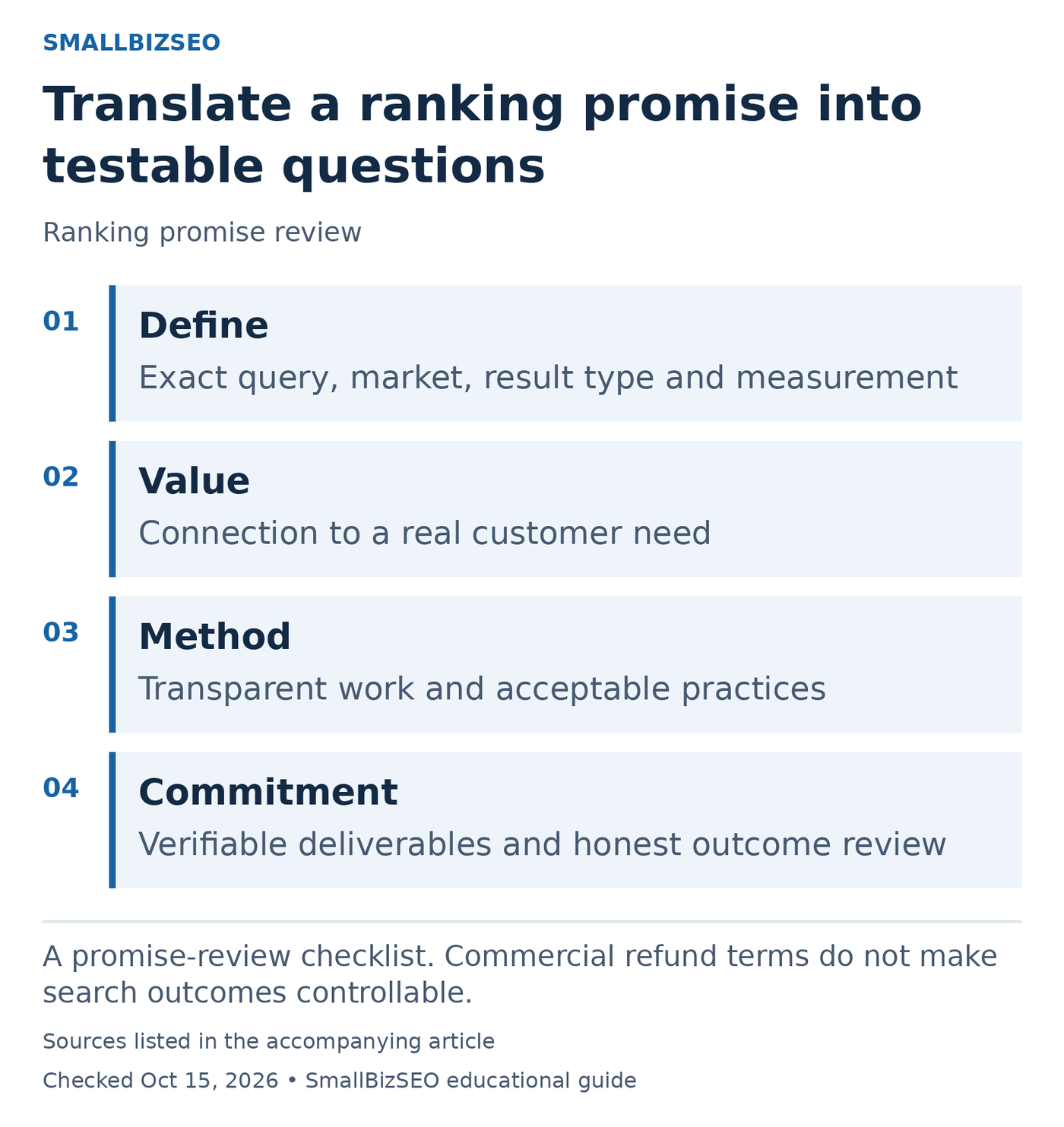
A promise-review checklist. Commercial refund terms do not make search outcomes controllable.
Sources: Google official guidance. Checked October 15, 2026. This visual is an editorial guide, not measured client results.
Define the result: ask which phrase, audience or location, result type, and measurement method are covered. A sponsored placement, a map result, and a conventional organic listing are different. A screenshot does not establish performance across every customer’s search.
Test its value: connect the phrase to a real service and a plausible buying need. Ask what suitable action a visitor would take after arriving. A prominent result for an obscure company-specific phrase may add little new demand.
Inspect the method: request the planned page changes and any proposed outside placements. A refund clause does not make a risky link arrangement safe. If the method is withheld, the business cannot meaningfully assess what is being done in its name.
Request controllable commitments: define deliverables, responsible people, approval checkpoints, and reporting expectations. Keep desired business outcomes visible while acknowledging uncertainty. Google’s explicit warning about number-one guarantees is a useful reference when comparing claims.
For a hypothetical service business, an approved page revision and a tested inquiry route are demonstrable deliverables. More qualified leads is the outcome to evaluate afterward. Prefer a proposal that makes both clear over one that substitutes an easy ranking target for the business goal.
Reference: Google’s official guidance. This checklist is an editorial planning aid; checked October 15, 2026.
Your next step
Replace “Can you guarantee first place?” with “What will you do, how will we assess qualified demand, and what will we change if the evidence is weak?”