


A competitor may rank above you because its page better matches the search, its business has stronger relevant signals, or the searcher's location favors it. A ranking difference alone does not reveal the exact cause or prove that the competitor has a better business.
Google describes multiple systems and signals used to rank pages. Treat competitor research as a way to find testable improvements rather than a way to reverse-engineer one secret factor.
Investigate the gap in five steps
Identify the result you are comparing. Is it a paid ad, a map listing, or a normal webpage result? These placements work differently. Record the actual query and the page that appears. Comparing your homepage with a competitor's highly relevant service page may reveal a content gap.
Check whether the search represents valuable demand. Would your ideal customer use this wording? Does the result page suggest people want to buy, compare, learn, or find a nearby location? A competitor winning an unrelated informational search may not be taking the customers you want.
Review both pages as a buyer. Can you understand the service, suitability, area covered, process, proof, and next step? Note questions the competitor answers clearly that your page leaves unresolved. Also identify useful evidence your own business can provide that the competitor cannot.
Check whether your page has a technical obstacle. Make sure the intended page is accessible and can be considered for search. Look for recent website changes and inspect the page in Search Console if you have access. Do not commission more content to solve an uninvestigated indexing problem.
Choose the most plausible improvement. Define what you will change, the page it affects, and what result you expect to observe. Keep a dated record and review relevant inquiries alongside visibility.
Location can change the comparison
For local results, Google identifies relevance, distance, and prominence as important factors. A business nearer to the person searching may have an advantage you cannot fix by repeating a place name on your website.
Use accurate business information and represent where you genuinely operate. Do not invent locations or create misleading pages to mimic a competitor's coverage. A single search from your office is also an incomplete view of what every potential customer sees.
Example: improve the buying decision
Hypothetical example: A flooring installer sees a competitor ranking for hardwood refinishing. The competitor's page explains eligible floor types, preparation, disruption, and relevant project examples. The installer's website only mentions refinishing in a short list of services.
A focused improvement would be to explain its genuine refinishing service and answer those customer questions using its own expertise. Copying the competitor's wording or creating a longer page without additional usefulness would miss the opportunity.
Pitfalls to avoid
Do not assume one visible difference caused the ranking. A higher link count, more reviews, longer copy, or a better-looking website is not a complete diagnosis. Third-party scores are clues from those tools, not Google's verdict.
Compare the customer experience, not just the position
Build a comparison note for one valuable customer search. Save the exact query, the date, your approximate search location, and whether you are comparing map results or website results. Record the actual competing page rather than treating every business with a similar name as the same competitor.
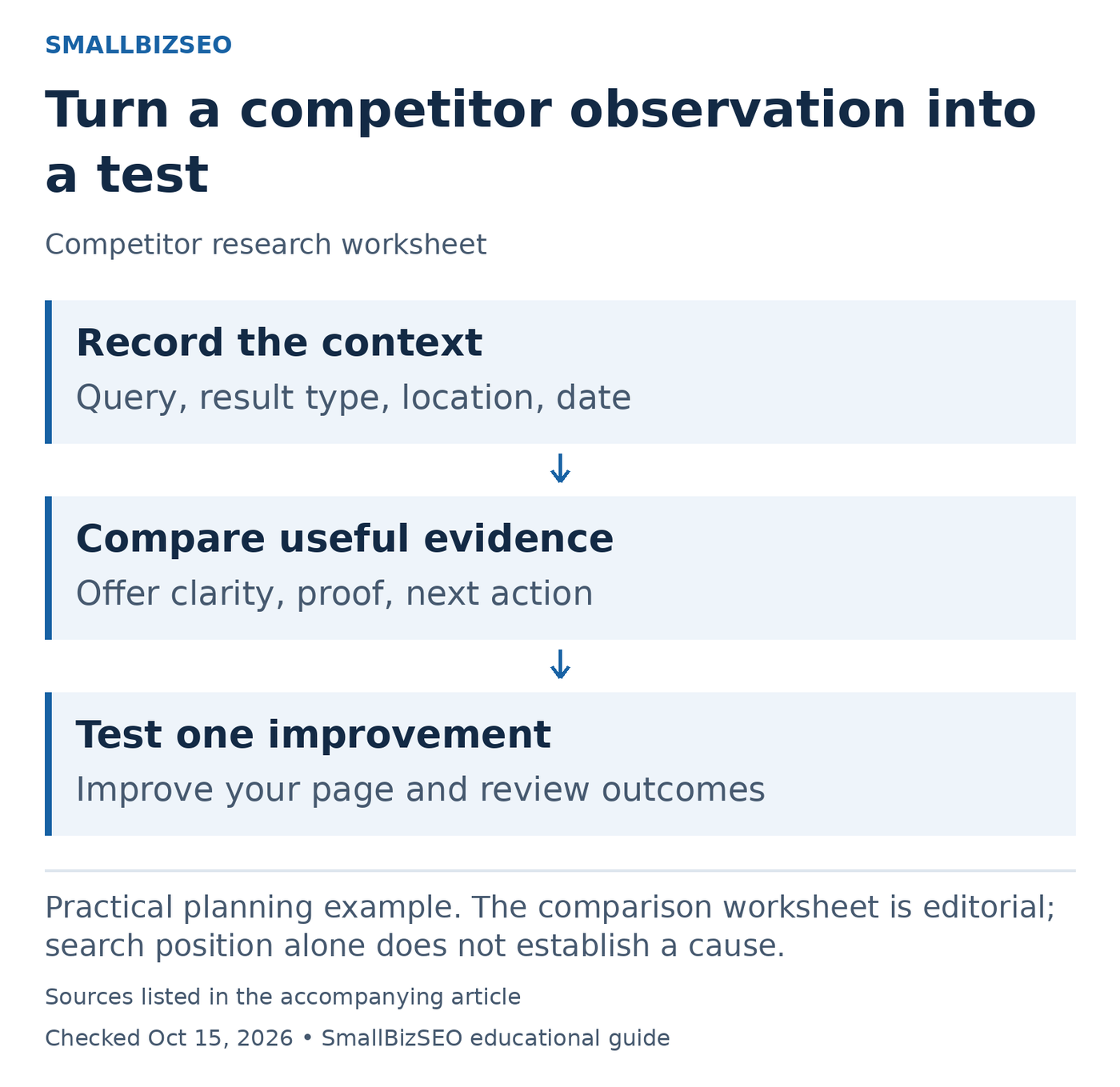
Practical planning example. The comparison worksheet is editorial; search position alone does not establish a cause.
Sources: Google people-first content guidance. Checked October 15, 2026. This visual is an editorial guide, not measured client results.
Open both pages and answer the same practical questions: Is the requested service easy to identify? Are important restrictions explained? Is there credible evidence of the work? Can a mobile visitor understand the next step? Mark each observation as visible evidence or a hypothesis. You can see a useful project example; you usually cannot see the competitor’s true conversion rate.
Hypothetical example: A competitor explains emergency availability clearly while your page simply says “contact us.” If emergency work is genuinely offered, clarify your own availability and contact route. Do not copy their promise if your team cannot fulfill it.
Choose one useful improvement and record why it helps the customer. Check the finished page and later compare relevant inquiries and search performance. A visible difference between two pages does not prove why Google placed one above the other.
Reference: Google people-first content guidance. The comparison worksheet is editorial; search position alone does not establish a cause.
Your next step
Compare one valuable query and the two relevant pages. Write down three observable gaps, then address the highest-impact gap you can support with real business information.