

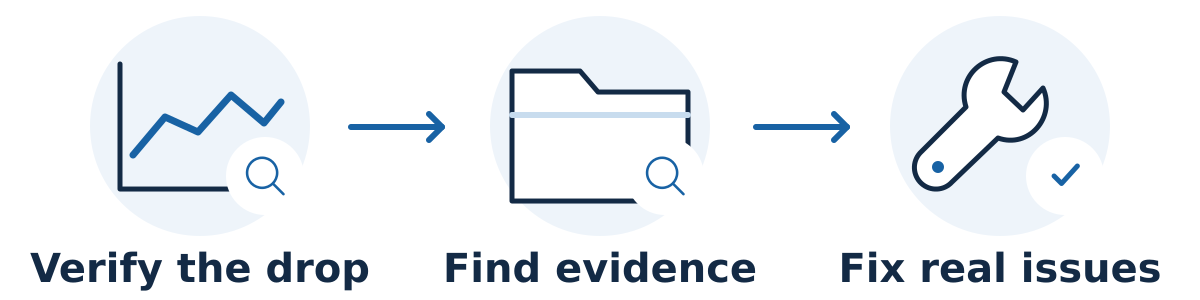
Has your website traffic dropped, or does it seem to have disappeared from Google? First separate a search-visibility change from a tracking problem.
A decline can come from several different causes: a measurement problem, reduced demand, a website change, technical access issues, stronger competition, or changes in Google's results. The right response depends on the pattern. A drop alone does not prove that Google penalized your site.
First, confirm what actually declined
Record the date, data source, affected pages, and metric. Search clicks, website sessions, rankings for one tracked keyword, and sales are different measures. Compare a meaningful period rather than reacting to an incomplete day or a single search from your own device.
Use Search Console's performance data to examine pages, queries, devices, and countries. If only an Analytics report changed, check tracking before assuming search visibility changed too.
Look for the scope and timing
Did the decline begin suddenly or gradually?
Is it site-wide, limited to one template, or concentrated on a few pages?
Did the business redesign, move domains, change URLs, or remove content?
Did the reporting setup or filtering change?
Does the same period normally have lower demand?
A hypothetical website that loses traffic immediately after a redesign deserves a different investigation from one whose seasonal service slows at the same time every year. Write down the facts before choosing a remedy.
Check urgent problems promptly
Confirm important pages load, contact paths work, and relevant technical settings have not accidentally blocked access or indexing. Review Search Console for security issues and manual-action notices. Google's traffic-drop troubleshooting guide provides a useful diagnostic sequence.
If customers cannot use the site or a critical page is unavailable, repairing that verified failure takes priority. Keep a record of the change and test the result.
Then assess search demand and competitiveness
Compare the affected topics with historical patterns and relevant market changes. Inspect whether pages still meet the customer's intent and whether the business's information remains accurate and useful. If a Google update coincides with the decline, that is context to investigate, not proof of a specific cause.
Google notes that small ranking fluctuations can resolve without radical changes. Avoid deleting useful pages, rewriting the whole site, or disavowing links merely because a chart moved.
Use the pattern to choose the next check
This diagnostic aid helps organize an investigation. A pattern suggests a question to test; it does not establish the cause. Google's traffic-drop guide recommends comparing similar periods, separating search types, and examining affected pages and queries rather than relying on a site-wide total.
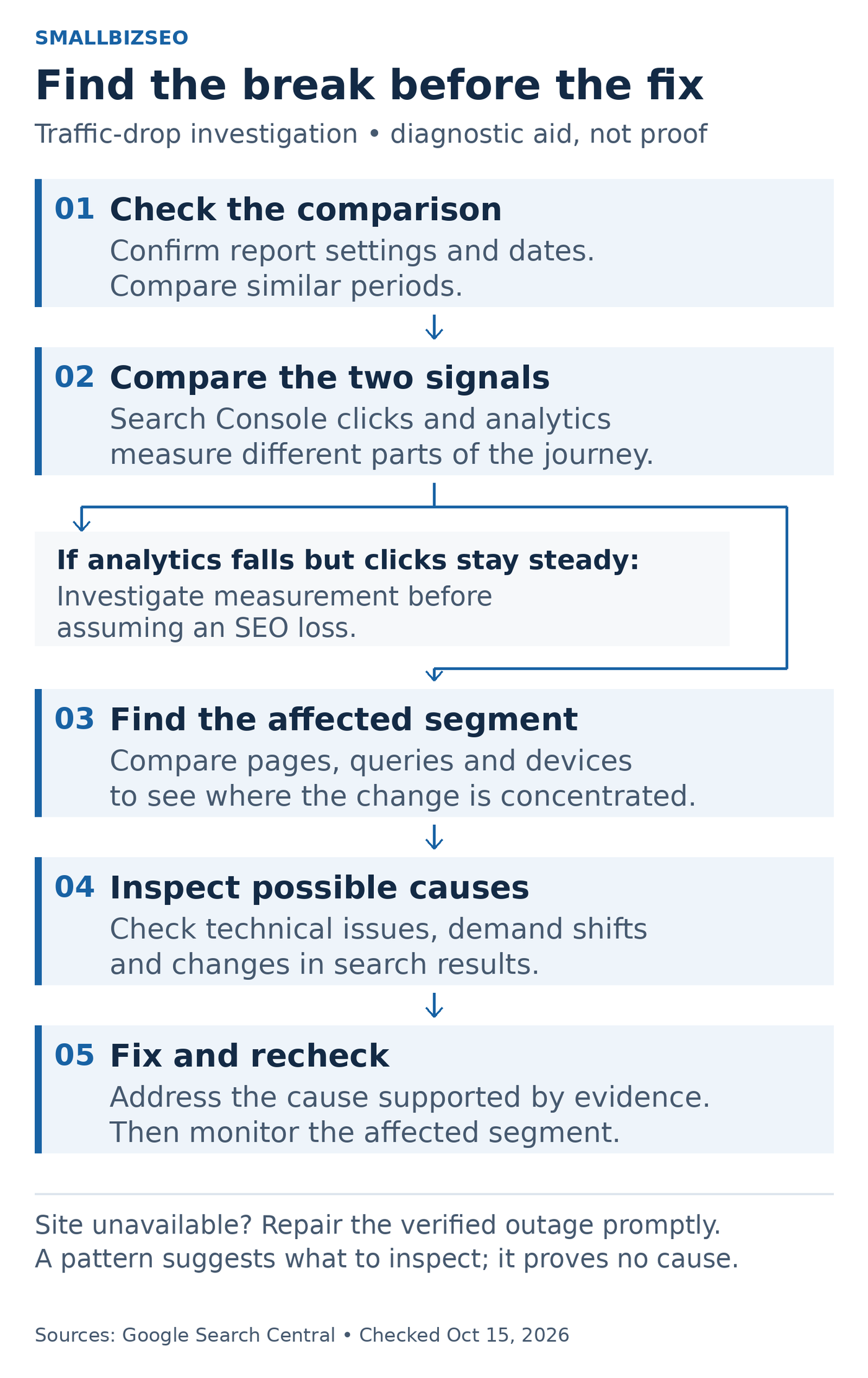
A diagnostic sequence, not a verdict. Similar-looking declines can have different causes.
Source: Google Search Central traffic-drop guidance; checked October 15, 2026. The sequence and worked example are editorial.
Analytics falls while Search Console clicks look broadly steady: inspect measurement changes, reporting filters, consent setup, and whether the reports cover comparable traffic. The two tools measure different events, so their totals should not be expected to match.
The loss is concentrated on pages changed in a redesign: inspect those exact URLs and the change log. Test availability, redirects, indexing settings, and internal links before commissioning replacement content.
Clicks and impressions fall for a seasonal service: compare the relevant queries with earlier seasonal patterns and wider demand. A broad business total can hide which service changed.
Impressions remain broadly steady while clicks fall: inspect the affected query/page pairs and current search results. Check intent, result presentation, and competitors before assuming that rewriting every title is the answer.
Turn a suspected cause into a test
Use a short investigation record: observed change → suspected cause → evidence needed → repair, if confirmed → verification.
Hypothetical example: An installation service page loses visibility after a redesign. The investigation finds that the live page mistakenly carries a noindex instruction. The website manager corrects the unintended setting, checks the live page, and records the repair date. Search Console can then help track what Google has processed. Confirming that the setting is fixed and observing a recovery in search traffic are separate checks; neither an immediate recovery nor a return to the previous ranking is guaranteed.
For an unexplained decline, save the starting evidence before changing several things at once. Agree who will test the suspected cause and which comparable report will be reviewed afterward. Repair a confirmed customer-facing outage promptly rather than waiting for a longer reporting window.
What should I send my SEO provider?
Send the affected URLs, date range, screenshots or exports, recent website changes, and any notices. Ask for the likely causes, supporting evidence, and a prioritized investigation plan. Agree on what will be checked after a fix. A documented diagnosis is more useful than a confident explanation that has not been tested.