

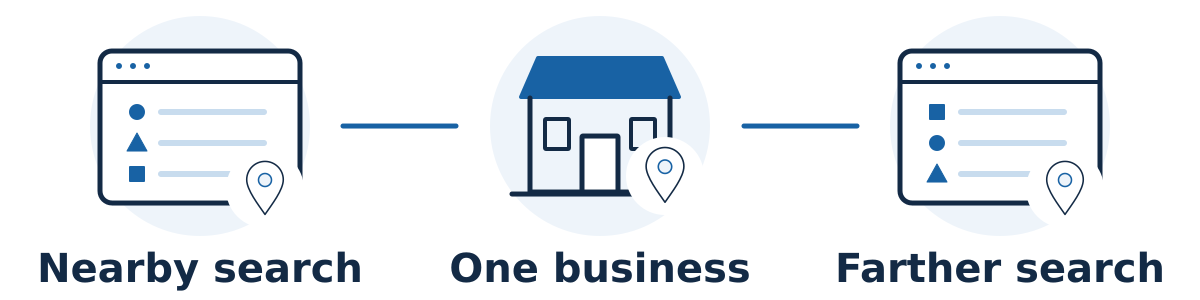
Google Maps results change across locations because distance is part of local ranking. Two people using the same search phrase from different neighborhoods may receive different results. A position observed outside your own premises is one snapshot, not a single ranking that every potential customer sees.
What changes the result?
Google identifies relevance, distance, and prominence as the main local factors. Relevance concerns the match to the search; distance concerns the searcher's location; prominence reflects how well-known the business is. Those factors interact, so the nearest provider is not automatically first. See Google's local ranking explanation.
The location Google uses can also differ from what you expect. Device information, an internet connection's approximate location, saved places, and some previous activity can help it estimate where you are. Google's location documentation explains these sources. An incognito window does not remove the geographic information inherent in your internet connection.
Compare observations on the same basis
Keep the query consistent: A broad category search and a specific service search are different tests.
Record the search context: Note the location, date, device, and whether you are viewing Maps or the local results within Search.
Use relevant locations: Focus on places where your actual customers are likely to need you, rather than an arbitrarily large area.
Look for a pattern: Compare like-for-like observations over time before treating one movement as a problem.
If a provider supplies a location-grid report, ask what each point represents and how the data was collected. Its findings should help explain coverage and customer opportunities, rather than stand in for actual inquiries.
A hypothetical example
A dog groomer appears prominently near its storefront but lower across town. That pattern alone does not show the profile is broken. If the groomer serves mostly nearby residents, the useful questions are whether those residents can find it and whether they book. Expanding the target area makes sense only if the business can attract and serve customers from it.
Focus on controllable improvements
Keep the profile accurate, make service information clear, and build a genuine reputation. Adding distant places to a service-area list does not move your physical operation closer to the searcher. Do not use an invented address to change the comparison.
Cross-check visibility with Business Profile performance and your own lead records. Google's calls metric counts call-button clicks, not completed conversations, and profile performance may include Google Ads activity. Directions and website clicks also should not be treated as completed sales.
Read a location grid as a set of observations
If a report uses a map grid, ask for a plain-language definition of each point. Does it represent an observation from that location, an estimate, or a tool-specific measurement? Keep the provider’s explanation with the report so later comparisons use the same method.
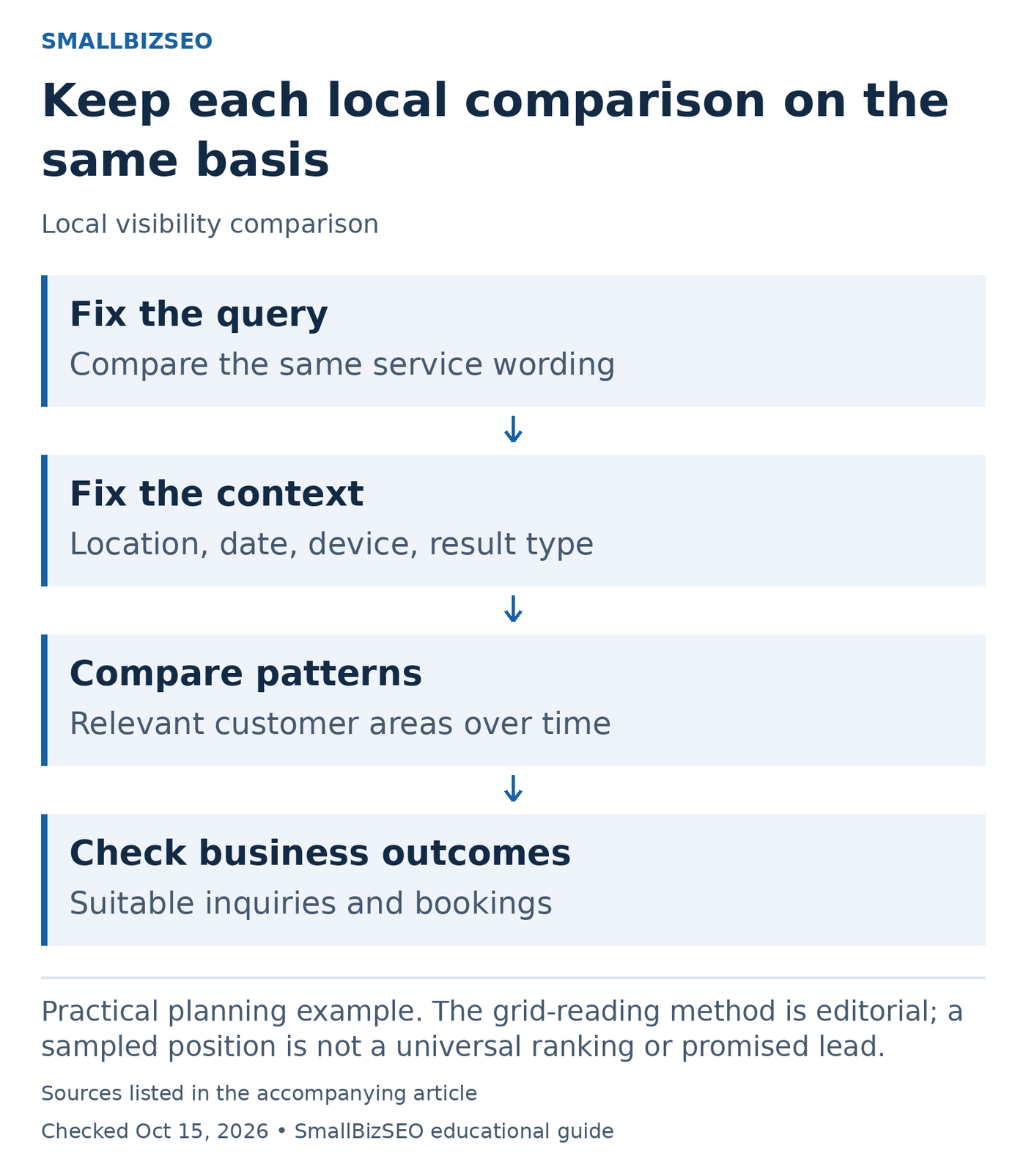
Practical planning example. The grid-reading method is editorial; a sampled position is not a universal ranking or promised lead.
Sources: Google local-ranking guidance. Checked October 15, 2026. This visual is an editorial guide, not measured client results.
Record the query, result type, observation date, and geographic area. Compare repeated observations for places where real customers are likely to need the service. Do not treat an empty cell, missing result, or tool cutoff as proof that no customer there can ever find the business.
Hypothetical example: A storefront performs well close to its premises and less prominently several neighborhoods away. Before buying work to make every grid square look alike, ask whether those distant areas represent realistic customers and whether suitable nearby inquiries are being missed. Geography changes the question as well as the observed position.
Choose a response only after checking the pattern alongside business records and accurate profile information. A sustained change near a key customer area deserves investigation; one different observation may simply require another comparable check. The useful objective is understanding relevant visibility and customer opportunity, not achieving a uniform grid or inventing extra operating locations.
Reference: Google local-ranking guidance. The grid-reading method is editorial; a sampled position is not a universal ranking or promised lead.
Your next step
Agree on a small set of relevant customer locations and search phrases, then review consistent observations alongside qualified inquiries. Investigate sustained changes rather than reacting to one ranking screenshot.