


Maintain the listings customers actually use to discover or verify your business, plus credible industry or local directories that serve your market. Fix wrong contact details and misleading duplicates before expanding the list. There is no universal number of directory submissions a small business needs, and buying hundreds of listings is not a reliable shortcut to rankings.
Clean up the listings that matter
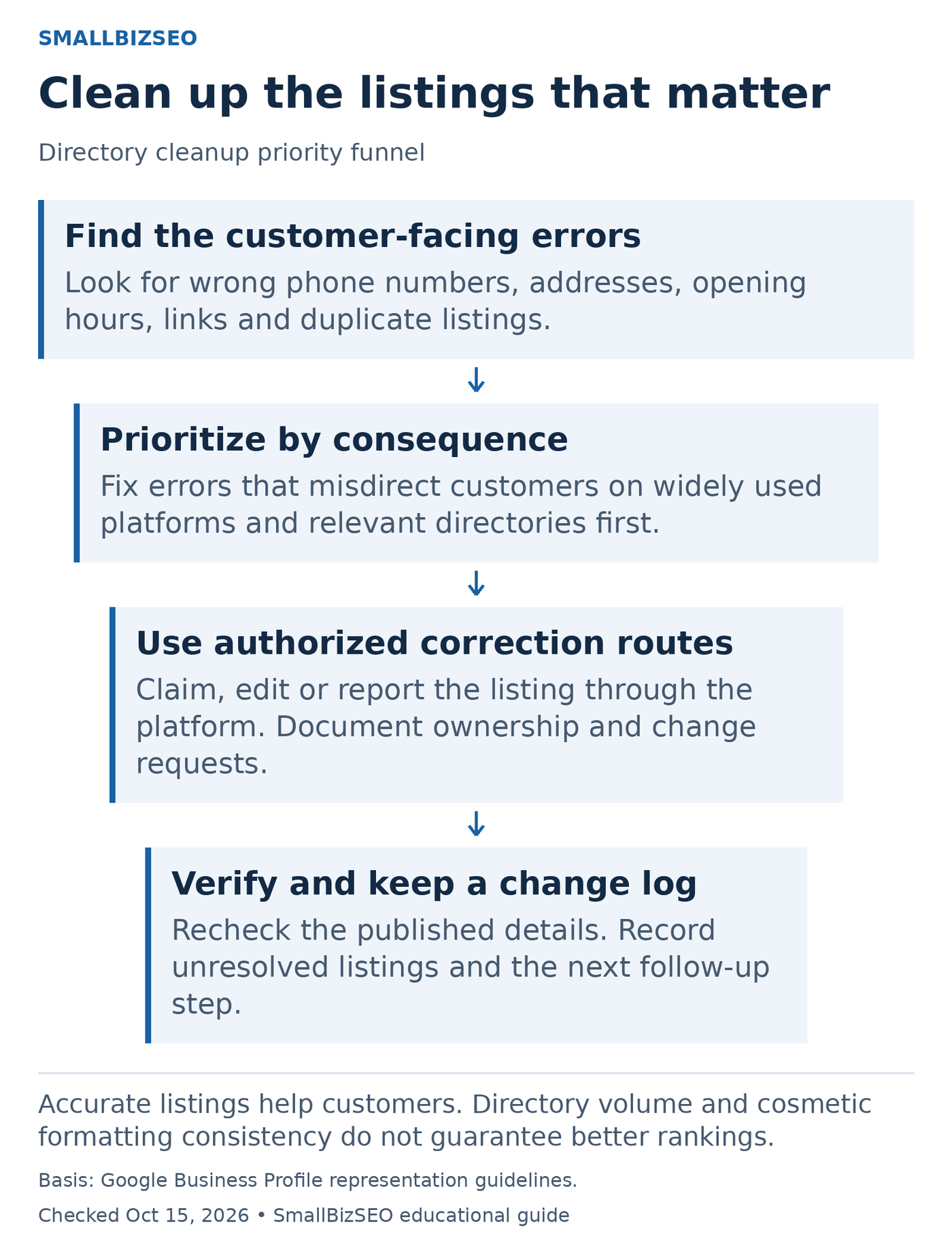
An editorial prioritization funnel for directory cleanup, focused on customer impact rather than a fixed number of citations.
Find the customer-facing errors: Look for wrong phone numbers, addresses, opening hours, links and duplicate listings.
Prioritize by consequence: Fix errors that misdirect customers on widely used platforms and relevant directories first.
Use authorized correction routes: Claim, edit or report the listing through the platform. Document ownership and change requests.
Verify and keep a change log: Recheck the published details. Record unresolved listings and the next follow-up step.
Accurate listings help customers. Directory volume and cosmetic formatting consistency do not guarantee better rankings.
Diagram references: Google guidance 1. Checked October 15, 2026.
Choose directories for a reason
Start with the profiles that appear when you search your business name, phone number, and main services. Include map services, relevant review platforms, trade associations, and local membership directories where your business legitimately belongs. A specialist directory used by your buyers may deserve more attention than a large general directory with no meaningful audience for your work.
Ask three questions about each candidate: Would a plausible customer use it? Can the listing accurately describe the business? Can you maintain it without an unreasonable cost or access burden? Record the reason for inclusion. This makes it easier to decline a package whose main selling point is the number of sites submitted to.
Paid membership can have value for networking or referrals. Evaluate that value separately from a promised SEO benefit. Google's spam policies identify low-quality directory links and links created primarily to manipulate rankings as link-spam concerns. A legitimate business listing and a mass link-building scheme are different decisions.
Create one approved business record
Keep a master record of the real-world trading name, public contact number, website, opening hours, and address or service coverage. Add the correct destination page for each genuine branch. Record which location details may be public; directory cleanup should not accidentally expose a home address that should remain private.
Consistency means the facts agree. Prioritize substantive errors, such as an old telephone number, a former location, the wrong branch URL, or hours that send customers to a closed shop. Cosmetic differences in punctuation are a lower priority than information that changes where someone goes or whom they contact.
Google's local-ranking guidance emphasizes complete, accurate profile information. It does not provide a required directory count or a guarantee that matching every character across the web will improve your position.
Build a correction queue
Use a simple worksheet with the listing URL, current error, correct fact, account owner, correction method, submission date, and public verification status. Distinguish “submitted” from “fixed.” A confirmation email does not establish that the public page has changed.
Start with high-consequence errors on prominent platforms. Next, correct genuine duplicates and important industry listings. Leave obscure, inactive pages until you have handled the places customers are likely to encounter. If a platform needs evidence or ownership verification, use its official process rather than creating another listing to bypass the problem.
For duplicate Google profiles, consult Google's duplicate-profile guidance. Confirm whether two records represent the same business or genuinely different eligible locations before requesting a merge or correction. Never assume that every shared address is a duplicate.
A hypothetical cleanup
A flooring installer discovers three problems: a major map listing has the old phone number, a trade-association page links to the wrong service page, and an obscure directory spells “Road” as “Rd.” The owner fixes the telephone issue first and tests the public call link. The association link comes next because it could misdirect a qualified buyer. The abbreviation is left for routine maintenance.
The business also finds a listing for a similarly named company in another town. It records that distinction instead of trying to claim or remove another company's profile. Good cleanup depends on correct identity, not just matching words.
Your listing-maintenance checklist
Search for current and former business names, addresses, and telephone numbers.
Select priority listings based on customer use, relevance, and visible errors.
Verify business identity and existing ownership before claiming or editing.
Submit corrections from the approved business record through official channels.
Test the published phone, website, directions, and branch destination.
Recheck unresolved items and assign an owner for future changes.
Know when to stop expanding
Once the important records are accurate, a service-page improvement or better inquiry handling may offer more value than another directory submission. Review listing maintenance after a move, name change, new branch, or contact change, with a periodic check of the most visible profiles.
Directory work cannot guarantee rankings, referrals, or inclusion in AI answers. Judge it by accurate public information, relevant referral visits, and useful inquiries where measurement is available. The next step is a short, prioritized correction queue, not a claim that the entire web must be perfectly synchronized.