


Local SEO helps a business get found by people looking for a nearby provider or place. Broader organic SEO helps website pages appear for relevant unpaid searches, including searches without a strong location requirement. Many small businesses need both, with the balance determined by where and how they serve customers.
Start with the customer's buying situation
A search for an emergency plumber usually requires someone who can reach the property. A search for an online bookkeeping service might lead to a provider hundreds of miles away. The useful distinction is whether proximity affects the purchase, rather than whether your company is small.
Local results can include Google Maps and business listings alongside ordinary website results. Google says its local results depend mainly on relevance, distance, and prominence. Those factors make the searcher's location important. See Google's explanation of local ranking.
What changes in the work?
For nearby customers: Prioritize an accurate, eligible Google Business Profile, real service coverage, useful location information, and a trustworthy customer-review process. Make it easy to call, book, find your entrance, or check opening hours.
For customers across a wider market: Prioritize clear service or product pages, the questions buyers ask before choosing, and evidence that your offering fits their needs. Delivery coverage, remote working arrangements, or industry expertise may matter more than your street address.
For both: Maintain a usable website with clear navigation and helpful content. A strong profile cannot explain every complex service, and an informative website cannot correct inaccurate hours in Maps.
Choose measurements that reflect each journey. Calls and direction requests may help assess a storefront's visibility; qualified inquiries from target markets may be more useful for a remote consultancy. Keep local listing performance separate from website performance when comparing progress.
A hypothetical example
A bicycle shop repairs bikes locally and ships specialist parts nationally. Its repair pages should explain workshop services, booking, and location. Its parts pages should answer compatibility, stock, and delivery questions. Publishing dozens of nearby-city articles would do little to help a buyer choosing the correct component.
Set realistic boundaries
Local SEO does not guarantee visibility from every neighborhood. Broader organic SEO does not require nationwide targeting. A regional manufacturer may pursue a small set of high-value business searches. An online-only business also should not assume it qualifies for a Business Profile; check Google's business eligibility guidance before creating one.
Map each offer to the customer journey it needs
Create an offer map rather than assigning the whole business to one SEO category. For each important offer, record where the customer can be, what they need to know, and the action that completes the buying journey. A mixed business may need different routes on the same website.
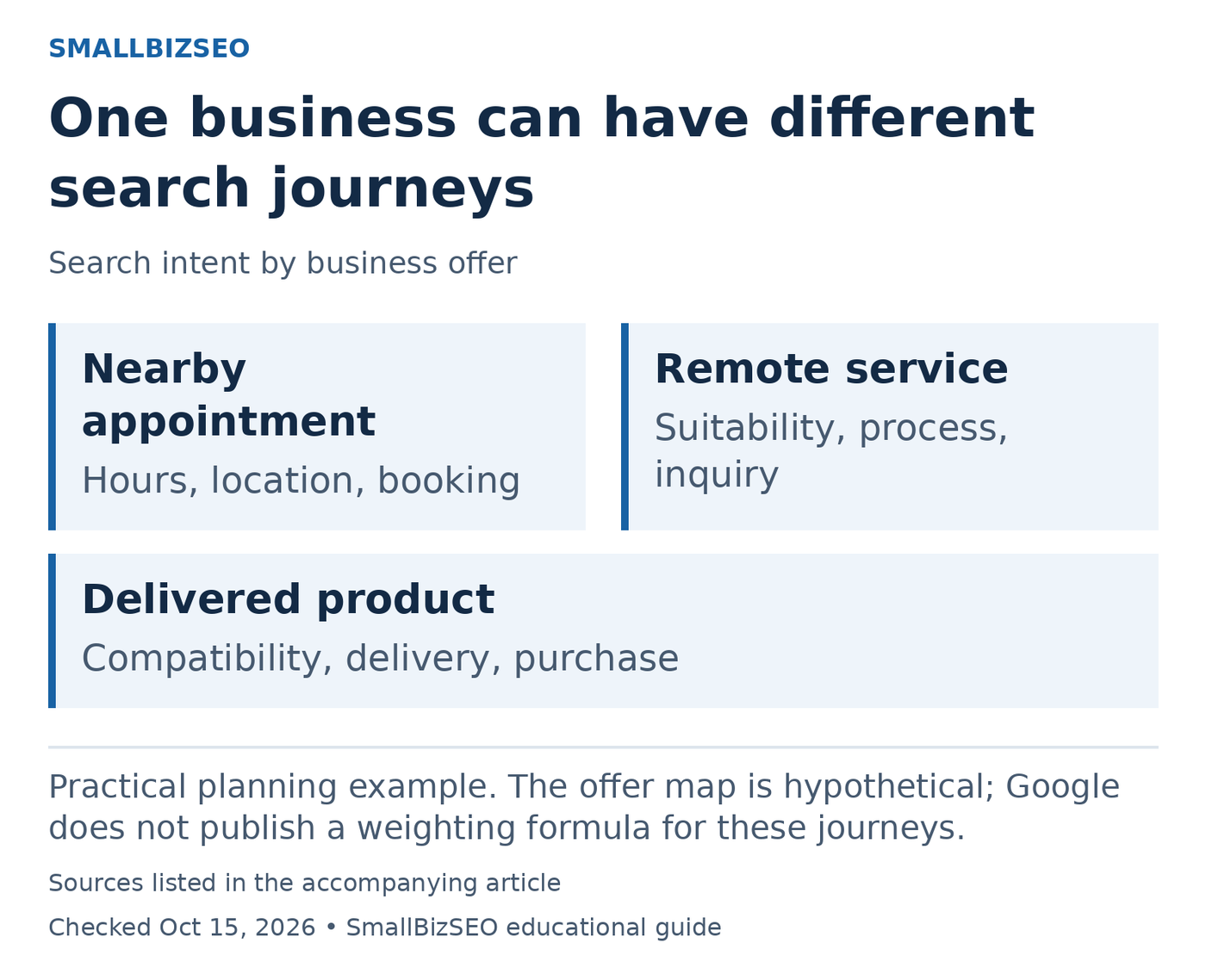
Practical planning example. The offer map is hypothetical; Google does not publish a weighting formula for these journeys.
Sources: Google local-ranking guidance. Checked October 15, 2026. This visual is an editorial guide, not measured client results.
Hypothetical example: A music shop offers in-person instrument repairs, remote lessons, and shipped accessories. Repair customers need accurate workshop details and a booking route. Remote lesson customers need to understand format, suitability, scheduling, and requirements. Accessory customers need reliable product and delivery information before purchasing.
Give each route an appropriate destination using existing pages where they already serve the need. A nearby customer can still discover a normal website result; a broader service page can still attract someone in the same town. These categories organize customer needs rather than divide every search into a rigid box.
Review each route with its own business outcome: suitable repair bookings, lesson inquiries, or completed accessory orders. Avoid blending them into one conversion target when that hides a weak journey. If a Business Profile is relevant, first confirm eligibility and accurate operating details. Do not create additional profiles merely because the business has several offers.
Reference: Google local-ranking guidance. The offer map is hypothetical; Google does not publish a weighting formula for these journeys.
Your next step
List your three most valuable offers and mark whether customers must be nearby, can be anywhere, or fall into both groups. Use that list to decide which pages and local information deserve attention first.