

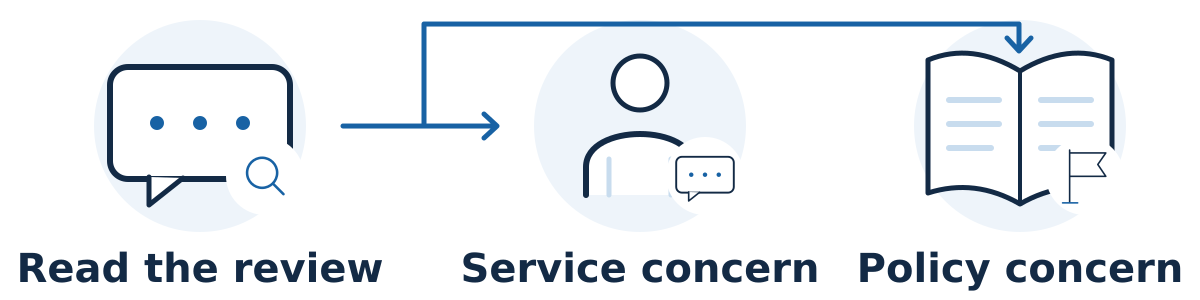
Treat a negative review as a customer-service issue first, and a suspected fake review as an evidence-and-policy question. Respond calmly when a reply would help, protect private information, and report reviews that violate Google's rules. A review is not eligible for removal simply because it is harsh, unfair in your view, or damaging to your average rating.
Choose the right review response
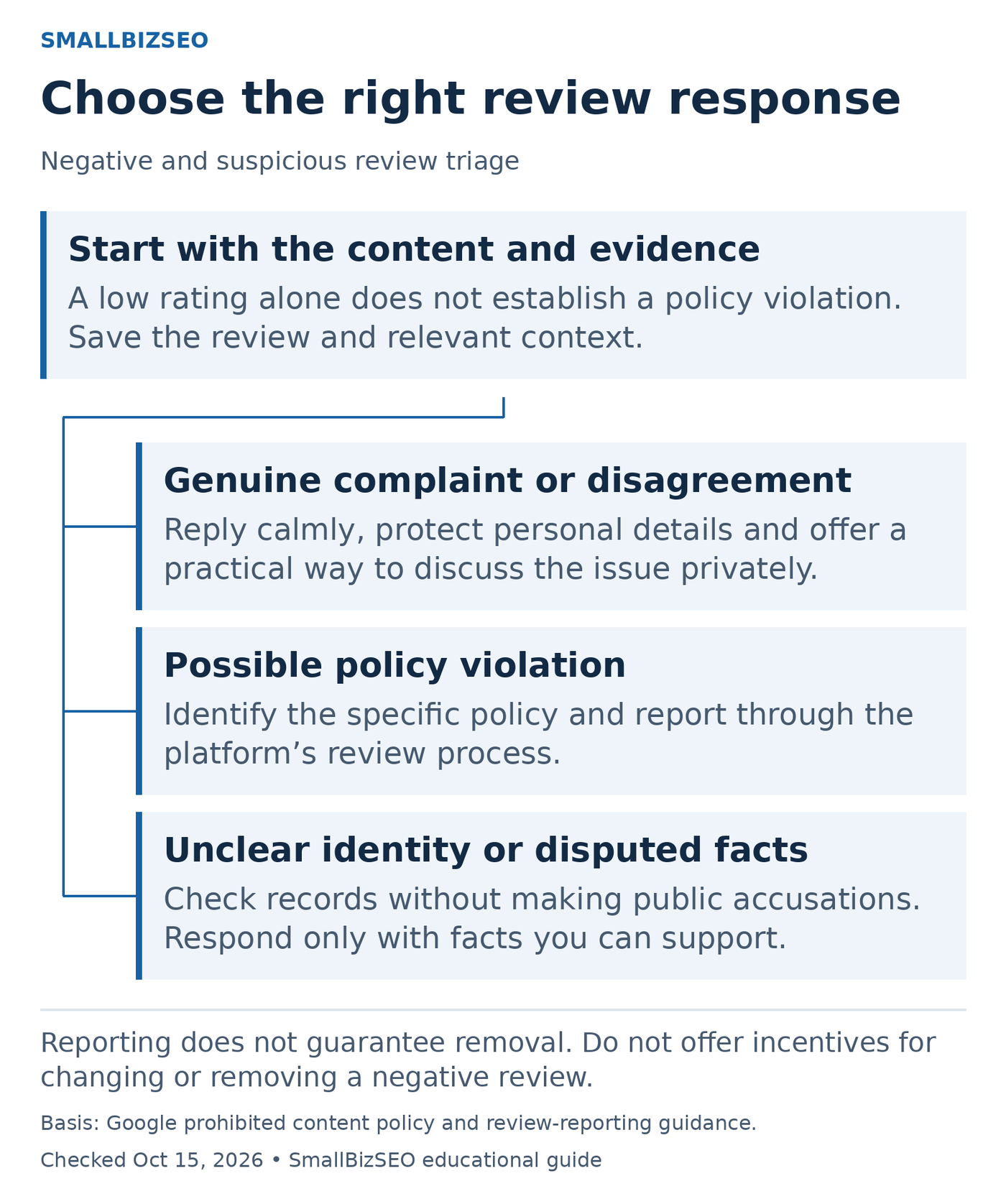
An editorial triage guide: distinguish customer dissatisfaction from a possible policy violation before choosing a response.
Start with the content and evidence: A low rating alone does not establish a policy violation. Save the review and relevant context.
Genuine complaint or disagreement: Reply calmly, protect personal details and offer a practical way to discuss the issue privately.
Possible policy violation: Identify the specific policy and report through the platform’s review process.
Unclear identity or disputed facts: Check records without making public accusations. Respond only with facts you can support.
Reporting does not guarantee removal. Do not offer incentives for changing or removing a negative review.
Diagram references: Google guidance 1 · Google guidance 2. Checked October 15, 2026.
Separate three different situations
A genuine complaint may describe something your business should investigate, even if you disagree with the customer's interpretation. A confusing review may refer to another business or a service you do not provide. A policy-violating review may involve fabricated engagement, harassment, prohibited personal information, or another defined violation.
Do not decide a review is fake solely because you cannot match its display name to a customer record. People may use different account names, accompany a customer, or describe an interaction that did not produce a purchase. Check the facts you can establish and avoid publicly accusing the writer of dishonesty without sound evidence.
Google's prohibited-content policy is the reference for deciding what to report. Keep your explanation tied to the relevant rule, rather than arguing that the review is inconvenient for the business.
Write for the next reader as well as the reviewer
A useful reply is short, professional, and specific enough to acknowledge the concern without publishing private details. If you can verify a service failure, describe an appropriate next step you are authorized to offer. If you cannot identify the interaction, invite the person to contact the business through a published support route.
For example: “We're sorry the visit did not meet your expectations. Please contact our team through the contact page so we can understand what happened and discuss the next step.” Adapt this to the facts; do not promise a refund, replacement, or deadline that has not been approved.
Avoid customer addresses, booking details, payment information, private correspondence, and screenshots of internal records. Even a reviewer who shares personal details has not given you permission to add more. A factual disagreement rarely benefits from a long public exchange.
Report a policy violation with a clear record
Google's review-reporting guidance provides a route from the review to a report, plus a Reviews Management Tool for checking the decision. Select the reason that actually fits. If Google finds no violation, the tool provides a one-time appeal for eligible reviews.
Prepare a concise record of the review link, date, relevant policy, and evidence supporting that policy issue. Keep internal records private and provide only information needed through an appropriate official channel. A report is a request for assessment, not a guaranteed removal or a way to settle a commercial dispute.
If someone demands payment in exchange for removing negative reviews, preserve the messages and use Google's dedicated extortion-reporting route linked from its review-reporting guide. Do not pay or negotiate for removal. Immediate threats or serious legal allegations may require appropriate professional or emergency help beyond an SEO workflow.
A hypothetical example
A garden-maintenance business receives a one-star review saying the team arrived late. The owner verifies a scheduling problem, replies briefly, and discusses the customer's concern privately. That criticism is not treated as spam merely because it hurts.
A second review contains repeated promotional links unrelated to any visit. The owner saves the review link and reports the specific policy concern. The two cases go into different work queues: service improvement for the first, platform assessment for the second. Neither outcome requires publishing the customer's identity or job details.
A practical review-response checklist
Save the review link and read the full text before reacting.
Ask the responsible team member what can actually be verified.
Classify it as a service concern, uncertainty, or a specific policy issue.
Draft a short public response without private details or unsupported accusations.
Report a genuine policy concern through Google's official process and track its status.
Record any operational fix separately from the review-removal request.
Use the available appeal only when there is a clear, relevant case to present.
Avoid fixes that create another problem
Do not offer discounts or gifts for deleting or changing a review, buy replacement praise, or recruit staff and friends to counterbalance criticism. Continue an optional, neutral review-request process for genuine customers rather than asking only the people most likely to leave five stars.
The goal is a trustworthy public record and better customer handling. Some negative reviews will remain. Track whether your response process is consistent and whether repeated service problems are being addressed; no reply template or removal service can guarantee a clean rating or better rankings.