

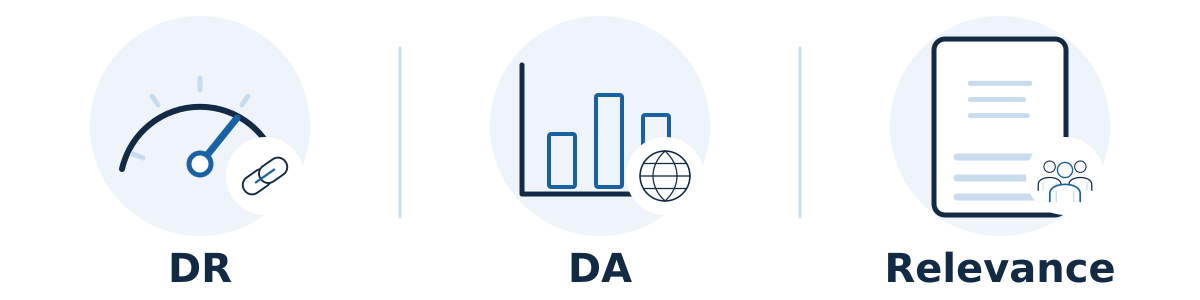
Domain Rating and Domain Authority are third-party SEO metrics. They can help compare websites within a tool's model, but they are not Google's internal scores, proof of business credibility, or guarantees that a page will rank. Use them as research signals alongside the actual website and your business results.
What is Domain Rating?
Ahrefs defines Domain Rating, or DR, as a relative measure of a website's backlink profile on a 100-point scale. Its value depends on Ahrefs' database and calculation. Ahrefs also explains that a score should be judged comparatively, rather than treating one fixed number as universally good.
Domain Authority, or DA, is a separate vendor metric associated with Moz. Do not treat the two names as interchangeable or directly compare a DA number with a DR number. Check which product produced the metric before interpreting a report.
What can these scores help with?
Getting an initial view of websites in a competitor or outreach research list.
Flagging changes that deserve a closer look at the underlying links.
Comparing similar businesses consistently within the same tool.
For example, a score difference might prompt you to examine where competitors earn relevant coverage. That can suggest an industry publication, useful resource, or partnership worth understanding. It does not mean copying every competitor link is sensible.
What do the scores leave out?
A single domain-level number does not tell you whether a particular page is accurate, useful to your customers, relevant to your business, or likely to send qualified visitors. It also does not establish whether a proposed link placement is editorially justified.
A hypothetical local trade association may be a valuable place for customers to discover a specialist business even if its vendor score is modest. Conversely, a high-scoring website can contain a page that has little relevance to your audience.
Read an authority score with its context
When a report highlights an authority score, add a context card beside it. Record the vendor, metric name, domain or subdomain measured, observation date, and the decision the score is supposed to support. Avoid comparing values from two vendors as though they were measurements on the same scale.
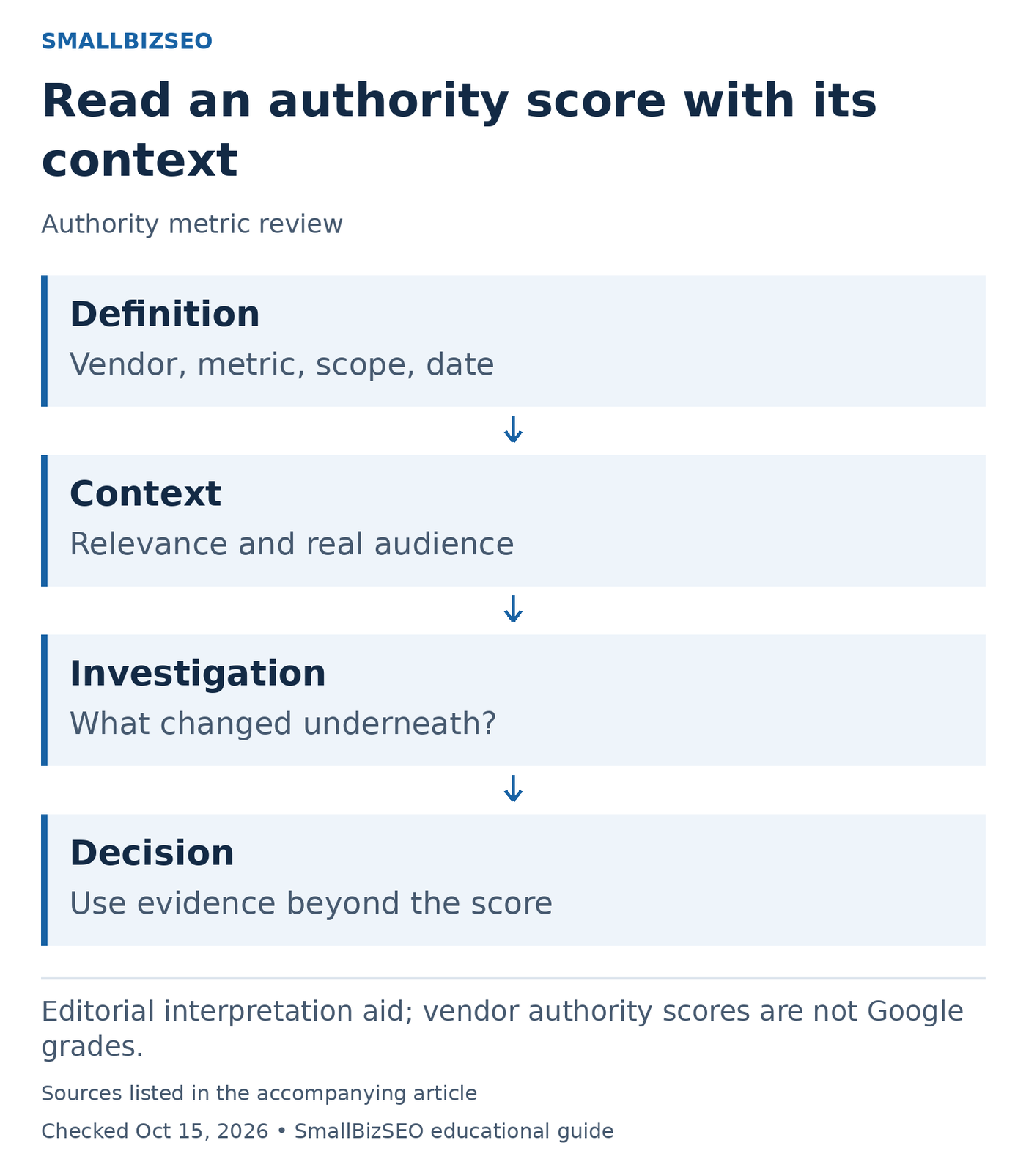
Editorial interpretation aid; vendor authority scores are not Google grades.
Sources: Ahrefs Domain Rating; Google on third-party SEO tools. Checked October 15, 2026. This visual is an editorial guide, not measured client results.
Hypothetical review: A relevant trade association has a modest vendor score but real members and a useful directory. An unrelated site has a higher score and sells links across many topics. The first may be a worthwhile professional resource; the second still needs a serious relevance and policy review. The number cannot decide either case on its own.
For an existing website, investigate the underlying change before celebrating or panicking. Ask which referring sites were discovered or lost, whether the vendor changed its index or methodology, and whether important pages or customer inquiries changed too. Keep screenshots or dated exports so the comparison uses a consistent definition.
Ahrefs describes Domain Rating as its measure of backlink-profile strength. Google’s guidance also cautions that third-party tools do not see its internal ranking data. Use the score to frame a research question, then make the business decision from relevant evidence rather than a target number.
Reference: Ahrefs Domain Rating · Google on third-party SEO tools
Should a higher score be an SEO goal?
Keep business outcomes ahead of the score. Ask whether relevant search visibility, useful visits, qualified inquiries, and customer acquisition are improving. If a provider proposes work mainly to increase DR or DA, ask what practical benefit they expect and how they will test it.
Google cautions that third-party SEO tools do not have access to its internal ranking data and cannot guarantee performance. A score change is a reason to investigate, not an automatic instruction to buy links, rebuild pages, or replace your strategy.
When reviewing your next report, identify the tool, the metric's definition, the comparison period, and the business question it helps answer. If nobody can explain that last point, the number probably deserves less attention.