

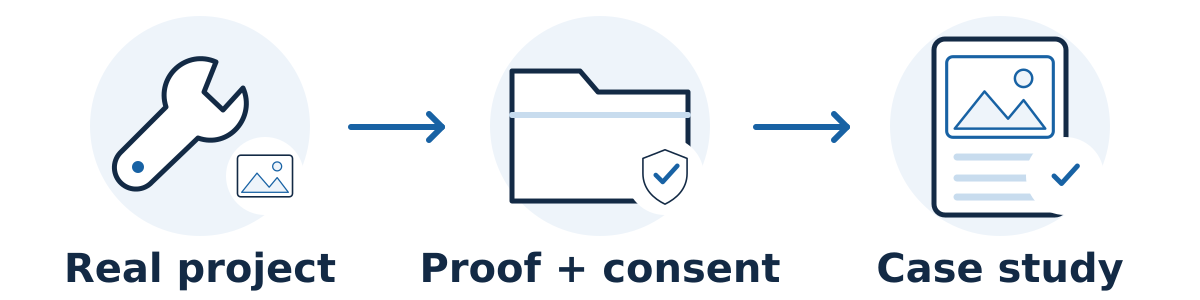
Build a case study around one real customer problem, the work you actually performed, and the outcome you can support with evidence. Obtain permission for the material you plan to publish, explain the project's constraints, and distinguish measured results from customer opinions. A modest, well-documented example is more credible than a dramatic story assembled from assumptions.
Turn project records into a case study
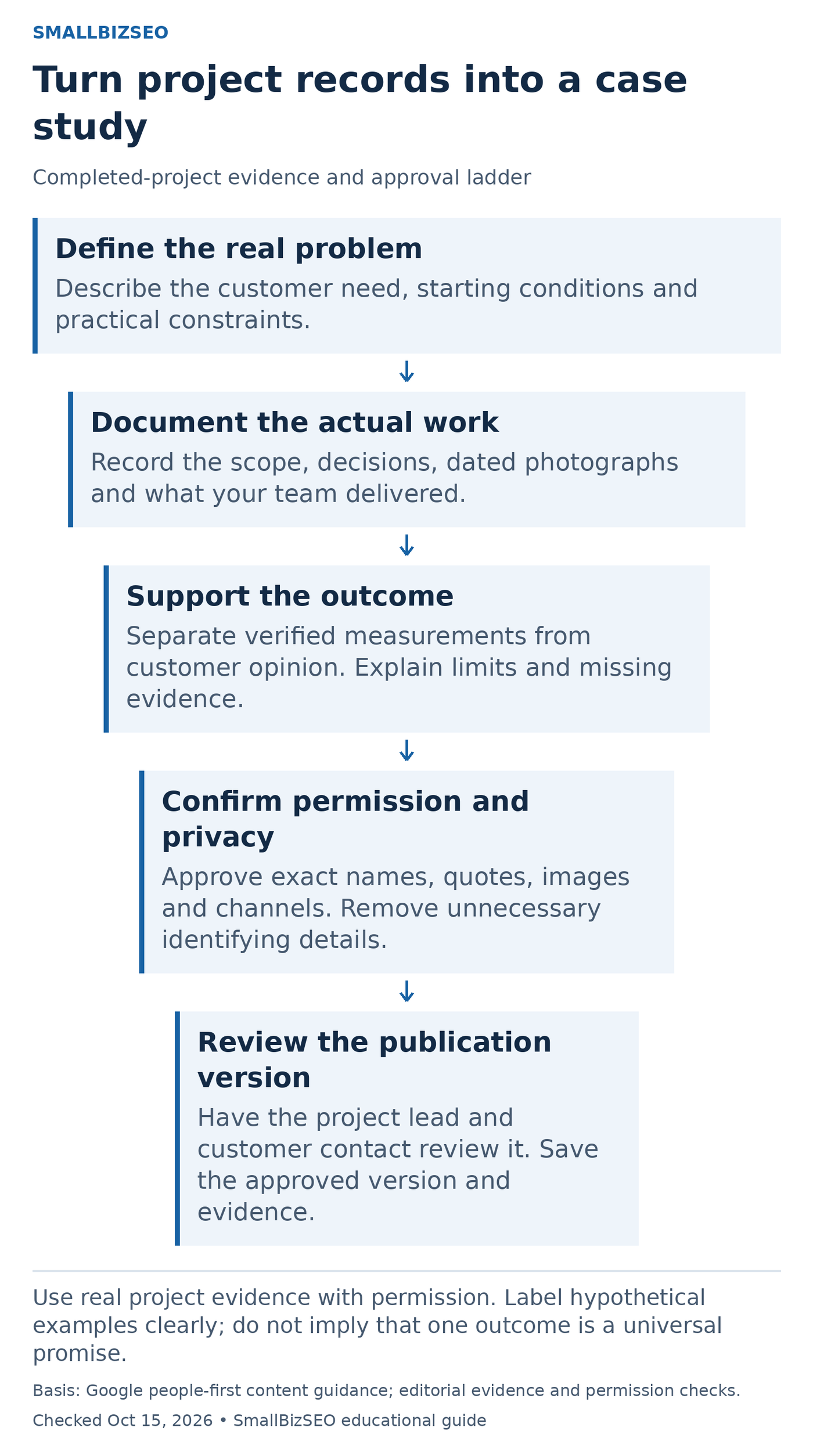
An editorial evidence and approval ladder for publishing a completed-project case study. No customer results or project images are represented.
Define the real problem: Describe the customer need, starting conditions and practical constraints.
Document the actual work: Record the scope, decisions, dated photographs and what your team delivered.
Support the outcome: Separate verified measurements from customer opinion. Explain limits and missing evidence.
Confirm permission and privacy: Approve exact names, quotes, images and channels. Remove unnecessary identifying details.
Review the publication version: Have the project lead and customer contact review it. Save the approved version and evidence.
Use real project evidence with permission. Label hypothetical examples clearly; do not imply that one outcome is a universal promise.
Diagram references: Google guidance 1. Checked October 15, 2026.
Choose a project that answers a buying question
Start with the question a prospective customer needs answered. Can your team handle an awkward installation? What happens when a project has limited access? How do you choose between repairing and replacing something? Select a completed job that makes your approach visible and is relevant to a service you still offer.
You do not need a famous customer or a spectacular percentage increase. Useful evidence can include an approved scope, dated work photographs, the options considered, inspection records, and a clear explanation of what was delivered. If the outcome was not measured, describe the completed work accurately instead of inventing a performance claim.
Google's people-first content guidance encourages evaluating original information, experience, and trust. A case study can supply those things, but publishing one does not guarantee rankings or citations in AI answers.
Assemble evidence before writing the story
Create a private project folder with the source for each proposed claim. Record who verified the scope, which dates apply, who took each photograph, and where any measurement came from. Keep public copy separate from raw customer documents so invoices, addresses, or private correspondence cannot slip into publication.
For numbers, explain the unit, baseline, comparison period, and method. If several changes happened together, do not assign all improvement to your contribution. A customer's statement that a room feels more comfortable is different from a measured energy saving. Label each appropriately and omit a number when the underlying evidence cannot support it.
Record complications too. Weather, an access restriction, a customer-supplied component, or work performed by another contractor can materially change how the example should be interpreted. Relevant limits make the story more useful to someone comparing their own situation.
Get permission for the actual publication
Confirm approval for the customer or business name, quotation, logo, photographs, project details, and planned publication channels. Ownership of your work does not automatically settle the rights to every image or detail. If an outside photographer supplied the pictures, verify the permitted use as well.
An anonymous case study still needs care. A distinctive exterior, exact location, vehicle plate, or combination of project details can identify someone. Use the minimum detail necessary, remove private information, and obtain appropriate permission. If permission or usable evidence is missing, choose another project or write an explicitly hypothetical educational example instead.
For U.S. advertising, the FTC's endorsement guidance explains that endorsements must be truthful, material connections may need disclosure, and exceptional results can imply misleading expectations. A generic “results may vary” line does not automatically cure that problem. Get appropriate advice for regulated claims or uncertain rights; this workflow is not legal clearance.
Use a structure a buyer can follow
Open with the project and the practical problem. Explain the relevant starting conditions, the options considered, the chosen scope, and how the work was completed. Then state the verified outcome and its limits. Finish with the related service and a realistic next step for someone with a similar need.
Use photographs to explain actual decisions, with captions that identify what changed. Do not present a stock image, AI-generated scene, or another company's work as project evidence. Before-and-after views should be comparable enough to avoid creating a misleading impression.
A hypothetical example
A cabinetmaker wants to explain a completed storage installation in a narrow room. With permission, the case study shows the original layout, the access constraint, and the finished fitted units. The text explains why shallow drawers were selected and which parts were excluded from the scope.
There is no measured resale-value or productivity result, so the page makes neither claim. An approved customer quotation is presented as that customer's opinion. The service link helps a reader request an assessment without implying the same design or delivery schedule will suit every property.
Your case-study publication checklist
Choose one buyer question and a relevant, completed project.
Match every claim to a record, measurement, or clearly attributed opinion.
Confirm permissions and remove unnecessary identifying details.
Draft the problem, constraints, approach, outcome, and limitations.
Have the project lead and appropriate customer contact review the exact version.
Test images, captions, related service links, and the inquiry route before publication.
Save the approved version and evidence for future corrections or updates.
Start with one project you can document properly. The finished page should help readers understand your work and judge fit, without asking them to trust invented numbers or assume one customer's result is a universal promise.