

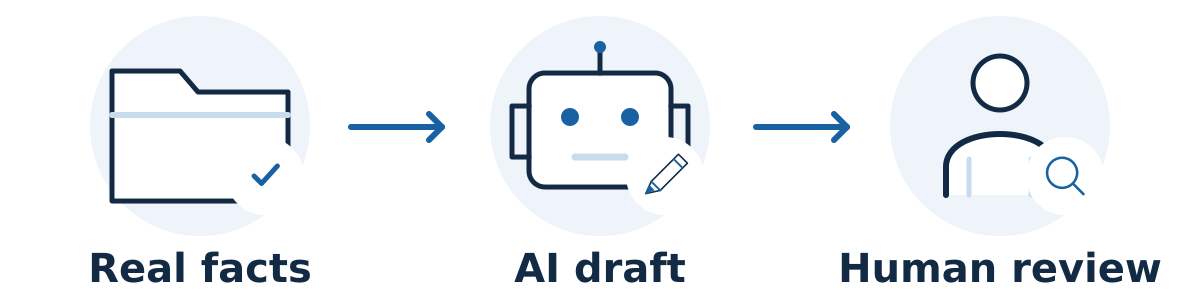
Yes. AI can help organize ideas, develop an outline, and improve a draft. A person should remain responsible for the final page's accuracy, usefulness, and business claims. Publishing large volumes of lightly checked text is a poor substitute for information your business is genuinely qualified to provide.
Start with the source material
Before drafting, collect the facts the page needs: service details, customer questions, relevant examples, limitations, and the intended next step. Decide who can confirm each important claim. An AI tool should not fill missing business facts with plausible guesses.
For example, a repair-business article should use the company's real service area and approved warranty details. If those facts are unknown, leave them out until verified. A polished paragraph can still make an inaccurate promise.
Use AI where it helps the work
Turn interview notes into a clear outline.
Identify unanswered questions in an existing draft.
Suggest simpler wording for a technical explanation.
Check whether a page repeats itself or drifts from its purpose.
Generate alternative headings for a human editor to assess.
Keep sensitive customer information and confidential material out of tools unless their use is authorized and appropriate. Use examples you have permission to publish, and do not invent reviews, case studies, or personal experience.
What should human review cover?
Google's AI-content guidance stresses accuracy, quality, relevance, and manual review. It also applies review to titles, descriptions, structured data, and image descriptions. The small fields around an article can make misleading claims just as easily as the main text.
Check names, numbers, dates, source links, service limitations, and any claim a customer could rely on. Read the page as a prospective buyer: does it explain what they need to decide, or merely sound confident?
How do I add something original?
Include relevant observations from your work, clearly explained examples, useful comparisons, and the tradeoffs customers actually face. Google's people-first content guidance is a useful quality reference. Original value can come from a clearer decision process, not just a previously unseen fact.
When describing a hypothetical situation, label it as an example. When describing an actual result, confirm the evidence and permission to share it.
Give every important claim an evidence check
A practical review sheet can be more useful than asking whether a draft “sounds human.” For each important claim, record the wording, its source, the person who can confirm it, and the decision: keep, qualify, or remove. Apply this to generated drafts and human-written drafts alike.
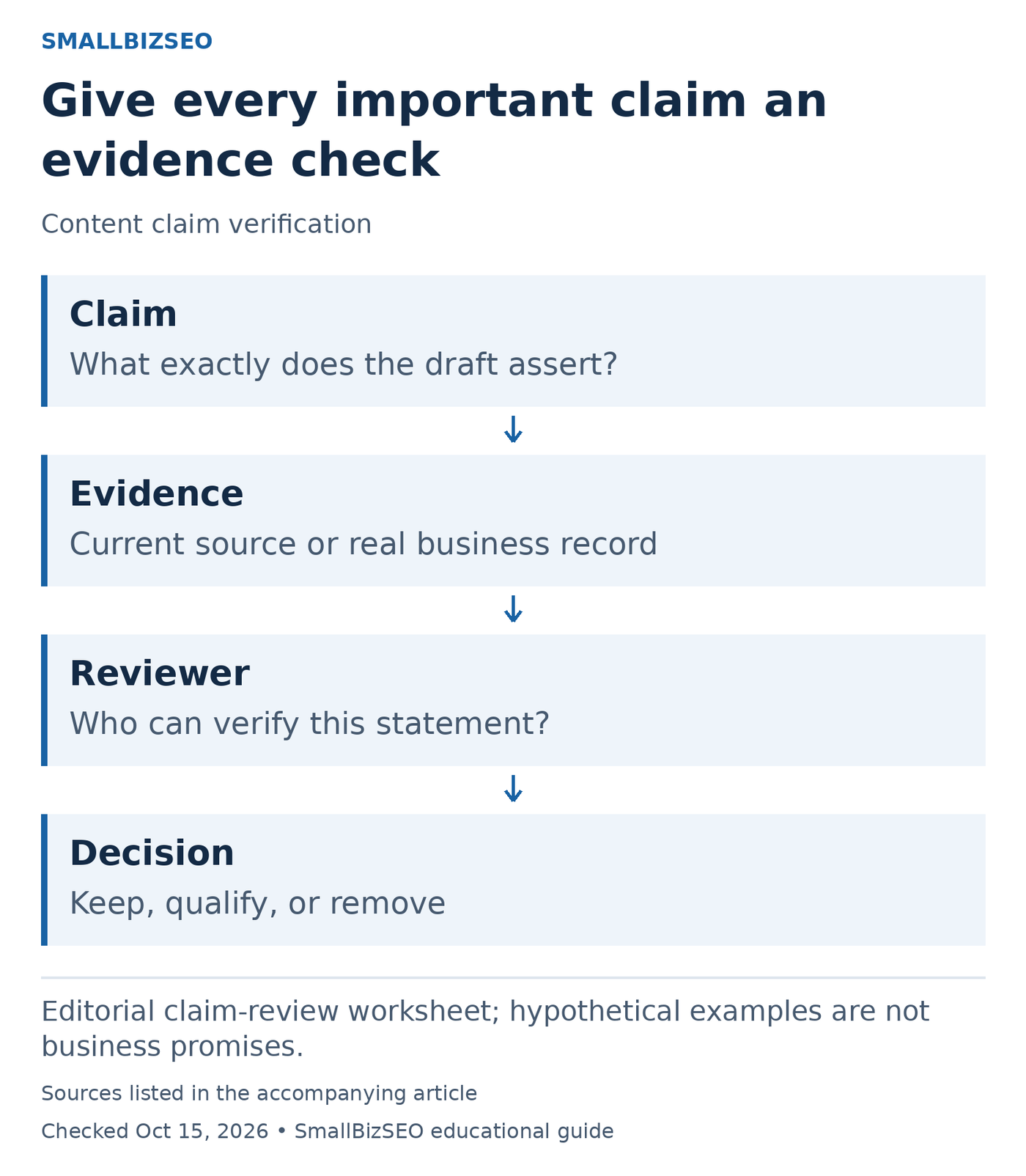
Editorial claim-review worksheet; hypothetical examples are not business promises.
Sources: Google generative AI content guidance. Checked October 15, 2026. This visual is an editorial guide, not measured client results.
Business claim: “Available every weekend” needs confirmation from the person responsible for scheduling. If availability varies, write the actual limitation rather than letting a confident sentence become a customer promise.
Technical claim: A statement about a search feature needs a current primary reference and a review date. Open the linked source and check that it supports the precise statement. A plausible title or citation suggested by an AI tool is not enough.
Experience claim: A project example needs a real record and publication permission. If it is invented to explain a process, label it hypothetical and avoid invented customer quotations, rankings, or results.
Finish by checking the small fields: page title, description, image alternative text, and structured data. Google explicitly includes those in its AI-content review guidance. Mark unresolved claims as blockers for publication, then keep the approved version with the review record so later updates have a trustworthy starting point.
Reference: Google generative AI content guidance
What should I avoid?
Avoid generating near-identical location pages, rewriting competitors' articles without adding value, or publishing claims you cannot verify. Google warns that scaled content created without user value can violate its spam policies. Finish with a named reviewer or clear internal owner, a review date where useful, and a plan to update facts when the business changes.