

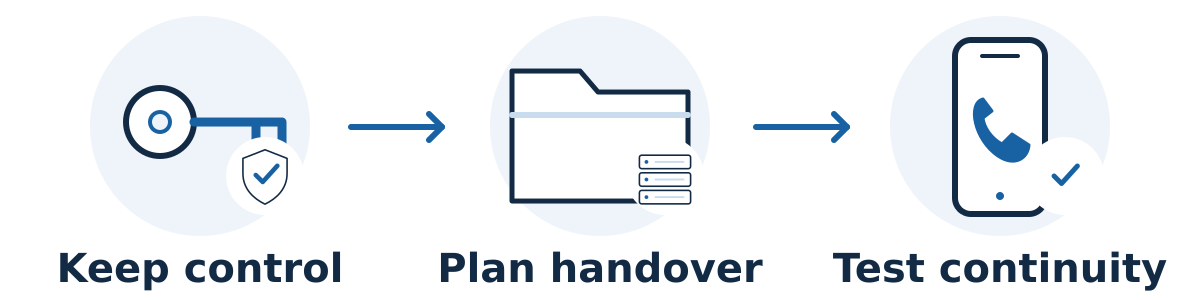
Switch SEO agencies with a written handover plan that protects your website, business accounts, and customer inquiries. Changing the people doing the work does not itself require a new domain, new website, or new analytics property. First establish what your business controls, what depends on the outgoing provider, and who will keep each service running.
The biggest avoidable problems are operational: an unpaid hosting renewal, a disconnected tracking number, a removed website license, or nobody knowing where quote requests go. Resolve those dependencies before the old arrangement ends.
Follow a practical handover sequence
Review the current agreement. Check notice requirements, outstanding work, asset ownership, cancellation dates, and any services bundled with the SEO fee. Ask which files, accounts, licenses, and phone numbers can transfer. Do not assume that paying for a website means every third-party subscription is yours to keep. Get unclear terms reviewed by an appropriate adviser.
Build an account and dependency list. Include the domain registrar, DNS, hosting, website administrator, business email, Search Console, analytics, tag manager if used, Business Profile, forms, booking tools, and call tracking. For each, record the business owner, billing contact, recovery contact, renewal date, and outgoing provider's role. Store credentials securely rather than in the handover document.
Confirm business-controlled access. Test your own login to the important accounts before removing anyone. For Business Profile, check who is primary owner. Google's ownership-transfer guidance includes restrictions during a new owner's first seven days, so leave enough time if a transfer is needed.
Collect the working record. Request a current backup, important URL list, redirect rules, tracking definitions, recent reports, completed changes, unpublished drafts, and known problems. Ask for the reasoning behind unusual settings. A list of changes without their purpose can lead the next team to undo something useful.
Agree on the changeover. Name who handles urgent website faults and approve a short period without nonessential changes. Preserve working page addresses and measurement where practical. If hosting or the website platform must also change, give that migration its own tested launch plan.
Remove access after continuity checks pass. Review named users, integrations, and recovery methods. For Search Console, removing a verified owner can also require removing their verification tokens; follow Google's permissions instructions without deleting your business's valid verification.
A hypothetical example
A landscaping company changes agencies and discovers that its quote form and call-tracking number are paid through the outgoing agency. The owner arranges a supported account or number transfer, tests incoming calls, and confirms form delivery before cancellation. The website stays on the same domain, while the new team receives the existing reports and a list of unfinished improvements.
That preparation protects the route from customer interest to an actual inquiry. A fresh design would not solve a disconnected phone number.
How do I know the handover worked?
Your business can access and recover the essential accounts.
Important pages load, the domain and hosting remain active, and renewal responsibility is clear.
A test call, form, and booking reach the right people and appear in the intended records.
The incoming provider has the agreed assets and can explain the next priorities.
Departing users and unnecessary integrations have been removed without breaking services.
Use a dependency test before cancelling access
Build a handover sheet around services that must keep working, not just a list of logins. For every dependency, record what it powers, who controls it, who pays for it, the transfer task, and the test that will establish continuity. Keep passwords and recovery secrets out of that sheet.
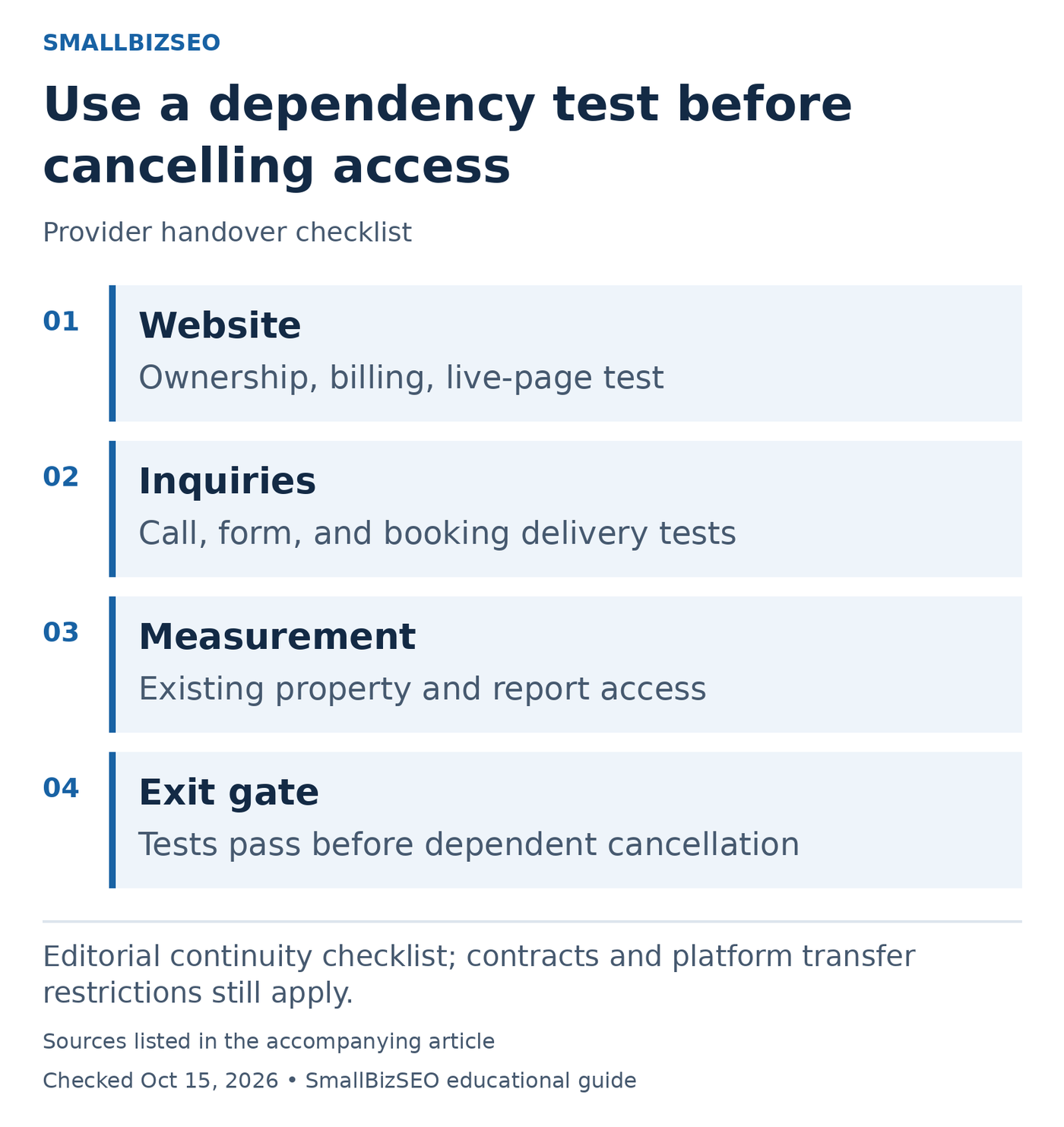
Editorial continuity checklist; contracts and platform transfer restrictions still apply.
Sources: Business Profile ownership transfer. Checked October 15, 2026. This visual is an editorial guide, not measured client results.
Website dependency: The domain, DNS, and hosting must continue serving the correct site. The acceptance test is a live page check plus confirmation of business-controlled administration and renewal responsibility.
Inquiry dependency: Forms, booking tools, email delivery, and tracking numbers must still reach the business. Run a test inquiry through each route and have the receiving person confirm it arrived. A visible form does not prove delivery.
Measurement dependency: Preserve access to existing reports, event definitions, and change history. Verify that the incoming team can read the right property before creating a replacement that breaks continuity.
Only mark a dependency complete when the actual test passes and any remaining restrictions are recorded. For example, Google documents a seven-day limitation period for new Business Profile owners or managers; plan around the specific transfer conditions. If a test fails, pause the dependent cancellation and assign a named person to resolve it. This checklist does not replace reviewing the provider agreement.
Reference: Business Profile ownership transfer
Common mistakes and your next step
Avoid cancelling everything at once, opening replacement analytics properties just to change providers, or rebuilding successful pages before reviewing the evidence. Keep a dated record of the handover and investigate sudden changes in inquiries or tracking.
Start with one shared checklist covering each account, dependency, owner, transfer task, and completion test. Agree on that checklist before choosing the final cancellation date.