

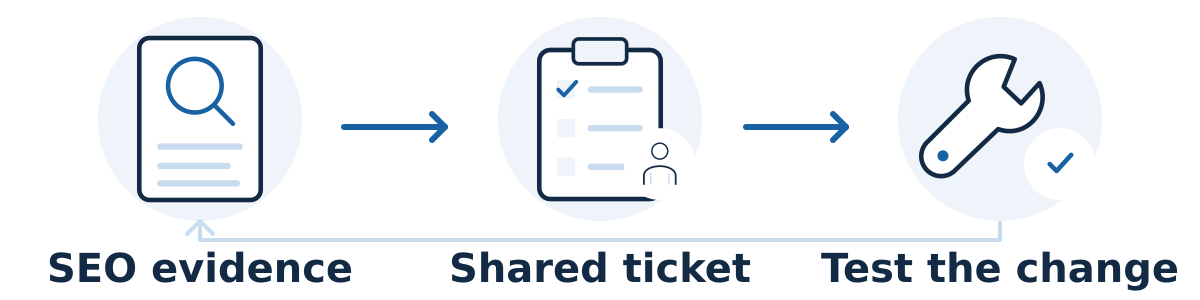
Your SEO provider and developer work best from one prioritized list of changes, with a named owner and a clear test for each item. The SEO provider explains the search or customer problem; the developer determines a safe implementation; the business owner approves priorities, budget, and consequential changes.
Turn recommendations into usable requests
“Improve technical SEO” is too vague to estimate or verify. A useful request identifies affected pages, the observed problem, the evidence, the desired result, and anything that must keep working. It should distinguish a site-wide template issue from a single-page edit.
For example: “The service menu opens a panel but provides no normal links to individual service pages. Add navigable links in this menu and confirm that keyboard users can reach them.” Google's link guidance explains why ordinary crawlable links matter for discovery.
Agree on a simple handoff
Prioritize by consequence: Address broken forms, inaccessible important content, or accidental search blocking before low-impact tidying. Ask both specialists to explain the risk and expected business benefit.
Assign ownership: Record who writes the specification, changes the site, reviews content, tests the fix, and releases it. Confirm whether developer time is included in either agreement or billed separately.
Plan the release: Use backups and a staging or preview environment where appropriate. Decide how to reverse a faulty change. Keep test pages private without accidentally carrying those restrictions onto the live site.
Define acceptance tests: Specify the relevant checks, such as correct redirects, accessible content, usable navigation, successful form submission, or intact measurement. Test representative mobile and desktop pages.
Verify after launch: Record the release date and affected URLs. Repeat functional checks on the live site and have the SEO provider inspect the relevant search evidence as it becomes available.
A hypothetical example
A landscaping business wants its quote form to load faster. The developer proposes removing a heavy script. The SEO provider identifies the landing pages affected, and the owner confirms that completed inquiries are the key outcome. Before release, the team tests that the form still submits and that a successful submission is recorded once. A faster page with a broken inquiry process would fail the acceptance test.
Keep technical success separate from ranking changes
A released fix can be verified before Google recrawls or reassesses a page. Search Console helps the team inspect indexing and search performance, but a completed ticket does not promise a ranking increase. Report what changed, what testing confirmed, and what remains to be observed.
Use a small release card for each consequential change
A release card keeps a technical recommendation understandable to everyone involved. Start with the affected page or template, the observed failure, and the expected customer behavior. Add the person making the change and the person accepting it; these roles may differ.
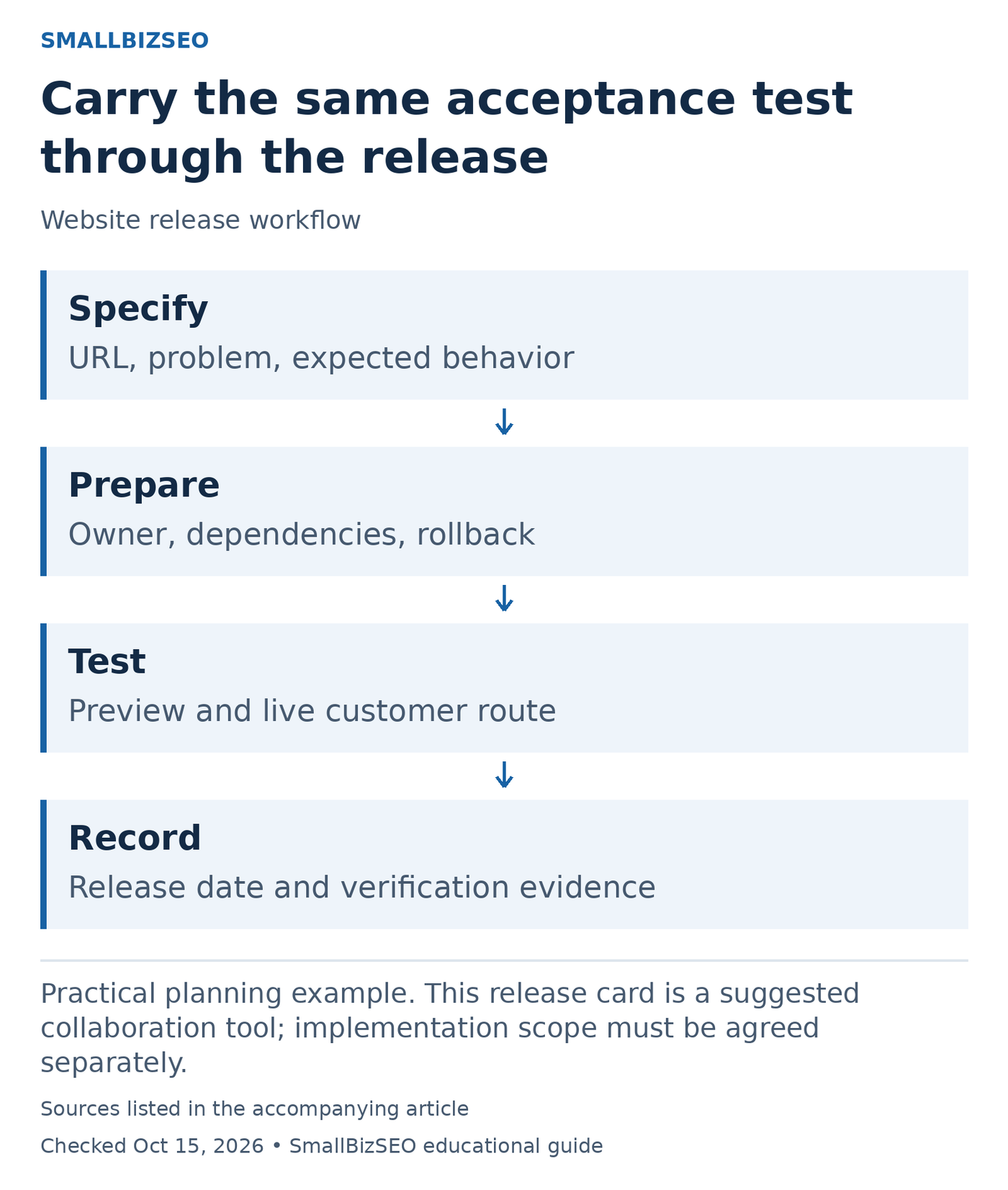
Practical planning example. This release card is a suggested collaboration tool; implementation scope must be agreed separately.
Sources: Google SEO Starter Guide. Checked October 15, 2026. This visual is an editorial guide, not measured client results.
Hypothetical card: “The service selector sends every choice to the general contact page. Update the repair option to the repair inquiry destination. On mobile and desktop, selecting repair must open the correct page, preserve useful context, and leave the other service routes working.” This describes behavior that can be tested rather than requesting a vague SEO improvement.
Before release, record dependencies and the recovery plan if the change fails. Preserve a way to restore the previous version where appropriate. Agree who can authorize release and who will be available to test the live site. A successful preview does not establish that the live deployment is correct.
After release, attach the actual test result, date, and affected URLs to the same card. Keep any later search-performance review separate from the immediate functional acceptance. If testing finds a failure, reopen the task with the observed behavior rather than marking it complete because code was deployed.
Reference: Google SEO Starter Guide. This release card is a suggested collaboration tool; implementation scope must be agreed separately.
Your next step
Ask both providers to select the three highest-impact unresolved changes and put an owner, estimate, acceptance test, and release dependency beside each one.