


Structured data is a machine-readable description of information on a page. Appropriate markup can help a page qualify for supported search features, but it does not guarantee a special appearance, higher rankings, or inclusion in an AI answer. The visible page must still provide useful, accurate information.
Where can structured data be useful?
Its value depends on the page and the search feature involved. A product page, an article, and a business-information page describe different things. Start with what the page actually contains, then check the relevant requirements instead of adding every available schema type.
For example, markup describing a product's availability should agree with the information customers see. If the product changes, the markup may need updating too. Structured data is part of maintaining the page, rather than a one-time decoration.
What rules matter most?
Google's structured-data guidelines require relevant, accurate markup that represents visible content. Correct syntax alone does not establish eligibility. Google also makes clear that valid markup does not guarantee a rich result.
Describe the correct subject and page type.
Keep facts consistent with what readers can see.
Follow the requirements for the particular supported feature.
Test the implementation and recheck it after relevant changes.
Avoid fake reviews, unsupported claims, or unrelated markup.
Will FAQ schema make our answers expand in Google?
No. As of this article's October 13, 2026 review, Google's documentation says FAQ rich results stopped appearing on May 7, 2026. The FAQ feature documentation was removed in June. You can verify this in the Google Search documentation changelog.
Older advice about FAQ rich results being restricted to particular health or government websites is no longer the current guidance. A useful FAQ can still answer customer questions and help visitors make decisions; that value does not depend on an expandable search result.
Should we remove every FAQ from the website?
No. Judge the actual content. Keep questions that resolve meaningful uncertainty. Improve unclear answers, consolidate repetitions, and remove information that is no longer accurate. A page can contain helpful questions and answers without qualifying for a special FAQ display.
Give every markup proposal a maintenance card
Use a small maintenance card before adding structured data to a page. Record the page URL, the thing being described, the intended supported search feature, the visible facts used, and the person responsible for updates. If the proposal cannot name a relevant feature or other concrete consumer of the data, clarify its purpose before spending development time.
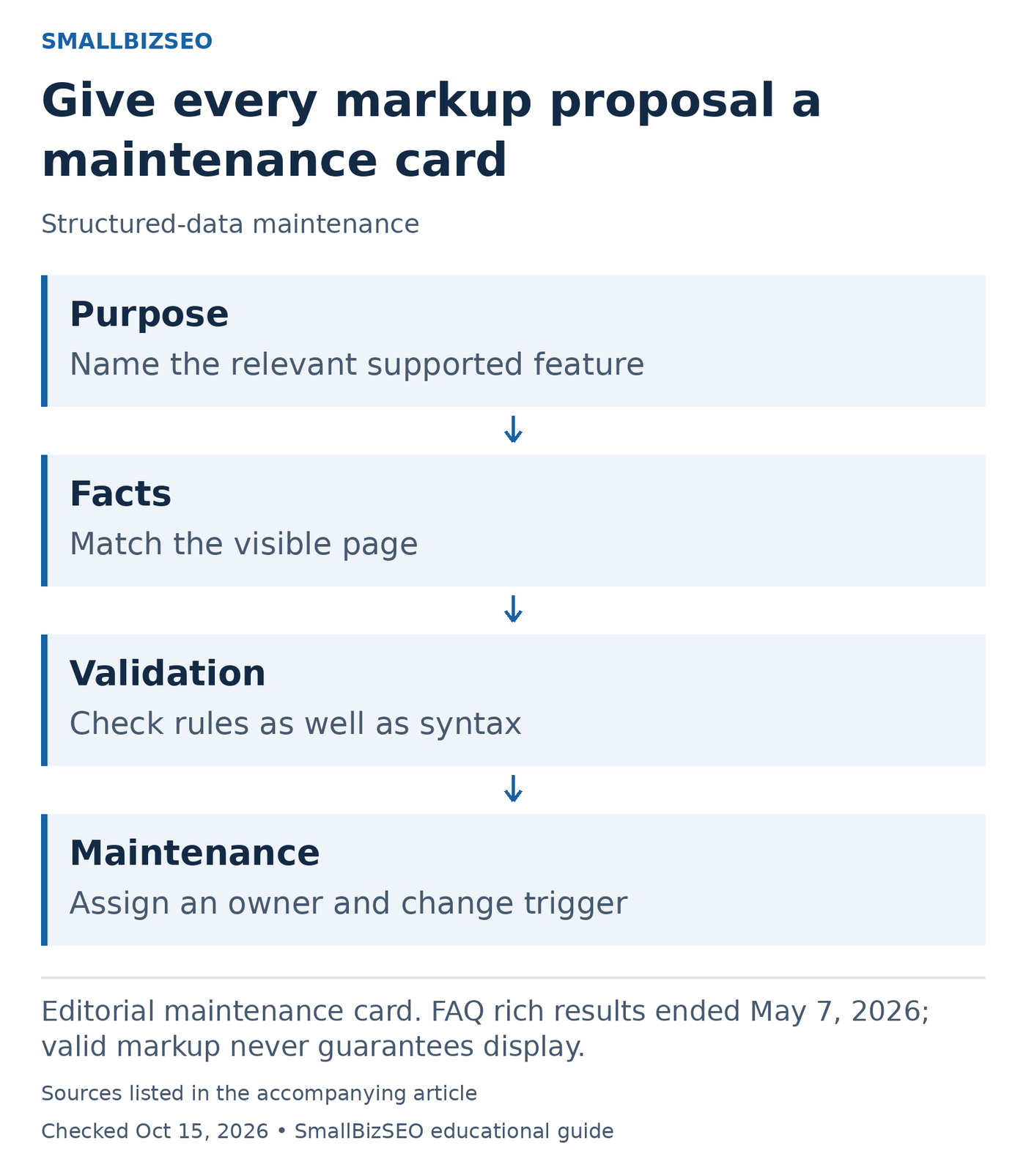
Editorial maintenance card. FAQ rich results ended May 7, 2026; valid markup never guarantees display.
Sources: Structured data guidelines; Google Search documentation updates. Checked October 15, 2026. This visual is an editorial guide, not measured client results.
Hypothetical product card: The visible product page supplies its name, price, and availability. The implementation uses those same underlying records where practical. A stock or price change triggers a check of the visible page and the generated markup together. Nobody invents an aggregate rating to fill an optional field.
Agree on three acceptance checks: the markup represents the right subject, the facts match what visitors can read, and the implementation meets the applicable feature’s current requirements. A successful syntax test answers only part of that review. Keep the test date and any unresolved warnings with the card.
For an FAQ, make content usefulness the first decision. Google stopped displaying FAQ rich results on May 7, 2026. Do not build a business case around restoring that display. Retain helpful answers, and assess any existing FAQ markup separately against its actual purpose and maintenance cost.
Reference: Structured data guidelines · Google Search documentation updates
What should I ask my SEO provider?
Ask which markup is proposed, which supported feature it relates to, and who will maintain the underlying information. If the recommendation is mainly “add schema everywhere,” request a more specific explanation. For a small business, accurate service details and a clear next step for customers are more useful starting points than unsupported promises about rich results.