

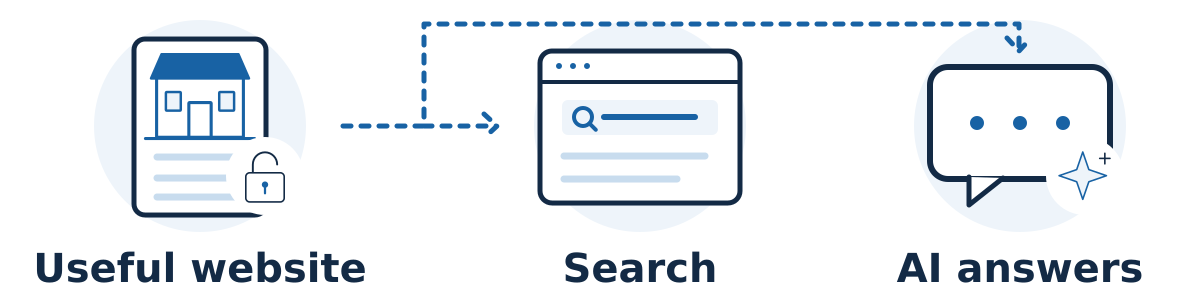
You do not need a separate set of special SEO tricks for Google's AI Overviews and AI Mode. Google's current guidance says established SEO practices remain relevant. The useful work is making your site accessible, accurate, distinctive, and helpful to the people whose questions you can answer.
What still matters?
A clear website gives visitors a reliable account of your services, products, experience, and limitations. Important pages should be discoverable, and the information on them should help someone complete a real task. If your best explanation is missing or outdated, fixing it is more useful than renaming ordinary SEO work.
For example, a specialist service page could explain the situations you handle, when your service is unsuitable, what a customer should prepare, and which evidence supports your claims. Those details help prospective customers assess the offer regardless of how they discover the page.
What does Google specifically say?
The current Google AI optimization guide emphasizes useful, non-commodity content and technical accessibility. It says special AI schema, an llms.txt file, and splitting answers into tiny chunks are not required for Google Search. Writing separate pages for every phrasing variation is not a substitute for usefulness.
Those statements are about Google. Other platforms can have different crawling controls, product features, and documentation. Check the provider rather than assuming one “AI SEO” rule applies everywhere.
Is there a setting that affects inclusion?
Yes. Google now documents a Search generative AI control in Search Console. Inclusion is the default, and a property's setting may inherit from a parent property. The control affects the listed Search AI experiences; it is separate from controls for model training.
If AI visibility is unexpectedly absent, review the site's actual setting along with ordinary access and indexing issues. Do not change controls without understanding the consequences or the business owner's intended policy.
Check eligibility before commissioning a rewrite
If an important page seems absent from Google’s AI experiences, use a short investigation record before making sweeping content changes. Start with the exact URL and the customer question. Record what was observed, where, and when; a single missing answer is only an observation.
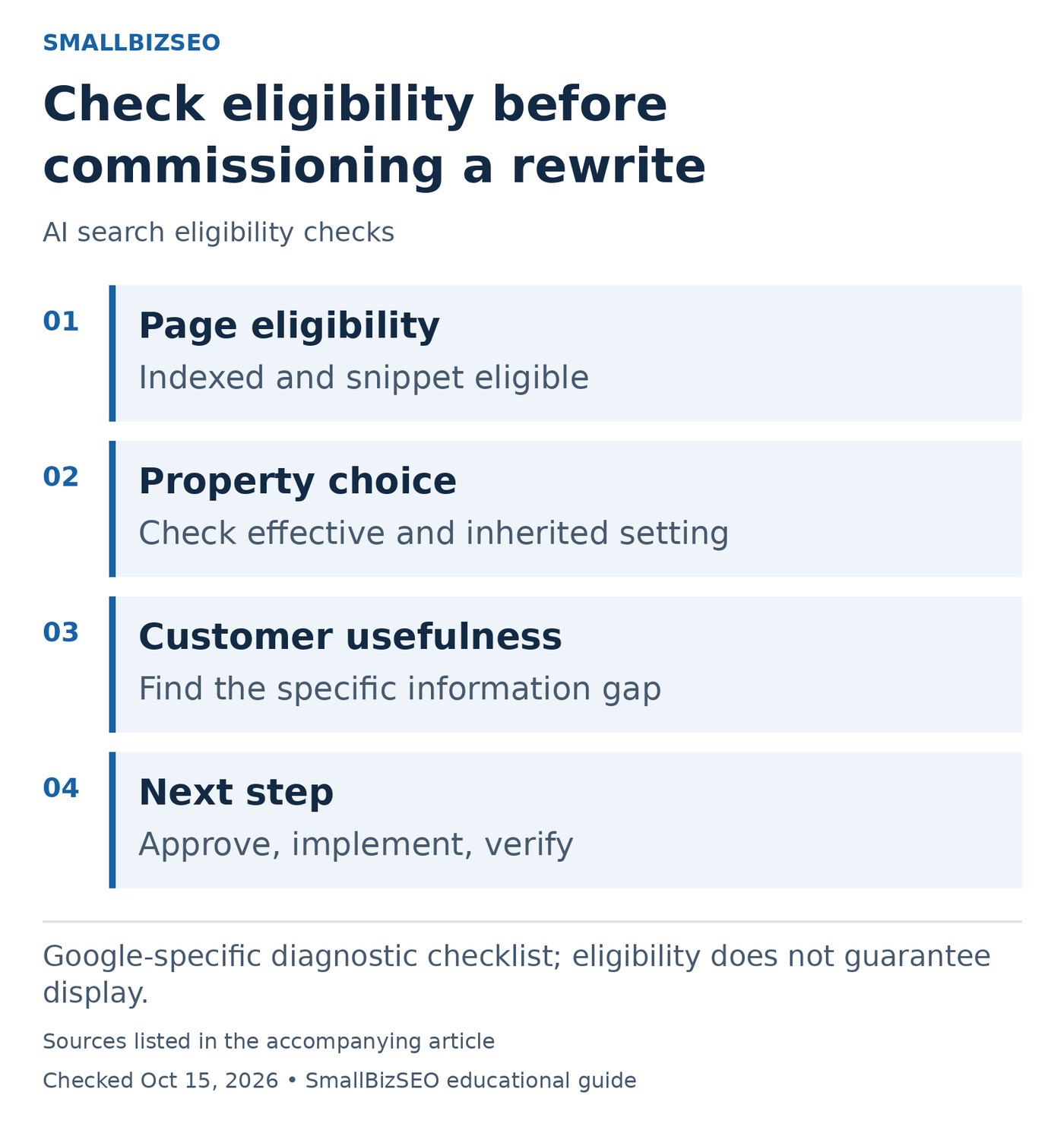
Google-specific diagnostic checklist; eligibility does not guarantee display.
Sources: Google AI optimization guide; Search generative AI control. Checked October 15, 2026. This visual is an editorial guide, not measured client results.
Check the page: Ask whether the intended URL is indexed, accessible, and eligible for a search snippet. If it is not, record the specific issue and the person responsible for checking it. Publishing more versions of the same answer does not resolve an access problem.
Check the property: Review the Search generative AI setting in Search Console, including whether it inherits from a parent property. Record the effective choice and the business owner’s intent before proposing a change. This inclusion control is separate from model-training controls.
Check the information: Once access and policy choices are understood, identify the actual unanswered customer need. A missing compatibility detail or unclear service boundary is a concrete improvement; adding a repeated keyword is not a diagnosis.
Close the record with an approved next step, a responsible person, and a verification method. Passing these checks establishes possible eligibility, not a right to appear. Keep observations from different AI products separate.
Reference: Google AI optimization guide · Search generative AI control
What should I ask an SEO provider?
Which customer questions and business outcomes are you targeting?
What information on our site needs improvement?
Which platform-specific requirements support the recommendation?
How will we separate visibility from visits and useful inquiries?
What result would tell us the work needs to change?
A good explanation should be understandable without relying on secret methods or guaranteed citations. Choose a few important pages, document their current condition and performance, and improve the information people need most. Review results over time while recognizing that Google determines when and how content appears.