

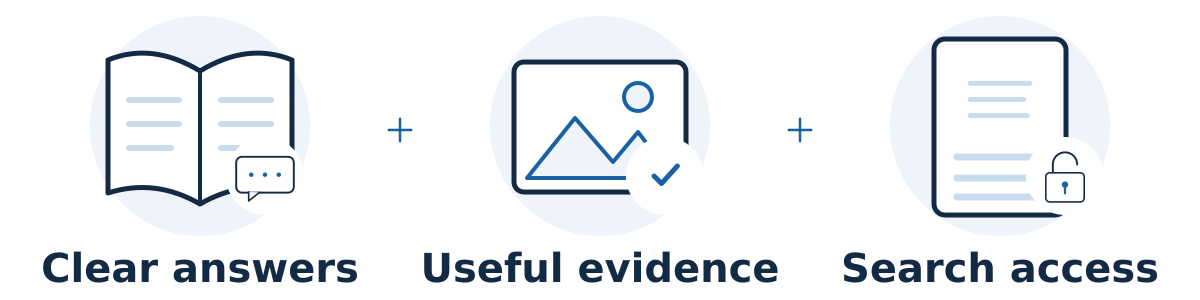
SmallBizSEO includes AI search visibility in its public SEO offering and publishes an evidence-focused Answer-Ready SEO framework. The practical goal is to make useful business information easier to find, understand, and trust. AI visibility should support your customer and business goals alongside ordinary search performance.
What does AI search visibility mean?
It can mean your business or content appearing in an AI-generated response, receiving a supporting link, or attracting a relevant visit from an AI search experience. Those are different outcomes. A mention may not produce a website visit, and a visit may not become a customer.
When discussing a service, identify which platforms and outcomes matter to your business. Google AI Overviews, AI Mode, and other providers' products are not interchangeable. Advice about one platform should not be presented as a rule for all of them.
What website work is worth discussing?
Clear business information: accurate descriptions of what you do, whom you serve, and how customers can take the next step.
Useful answers: pages that resolve genuine customer uncertainty with enough context to make a decision.
Evidence: relevant examples, original knowledge, transparent limitations, and support for important claims.
Technical access: important information that can be discovered and processed by the relevant search systems.
Measurement: a baseline and a way to assess visibility, visits, and meaningful customer actions.
This is a practical evaluation checklist. Ask which activities are actually included in your SmallBizSEO scope and how they relate to the platforms you want to reach.
Does Google require special AI optimization?
Google's current AI optimization guide says established SEO practices remain relevant. It emphasizes distinctive, useful content and sound technical foundations. It does not require special AI schema, tiny answer chunks, or an llms.txt file for Google Search. Creating separate pages for every question variation is not a useful substitute for a strong answer.
A practical example is a service comparison that explains who each option suits, its limitations, and the facts behind the recommendation. That gives a prospective customer something useful to evaluate. It is more defensible than repeating broad claims that any business could make.
Turn an AI visibility goal into a work brief
Before approving a proposal, choose one customer decision you want to support. Write a short brief with five fields: the customer question, the page that should answer it, the missing evidence, the person who can verify that evidence, and the observation you will review afterward. This makes a broad visibility ambition easier to evaluate.
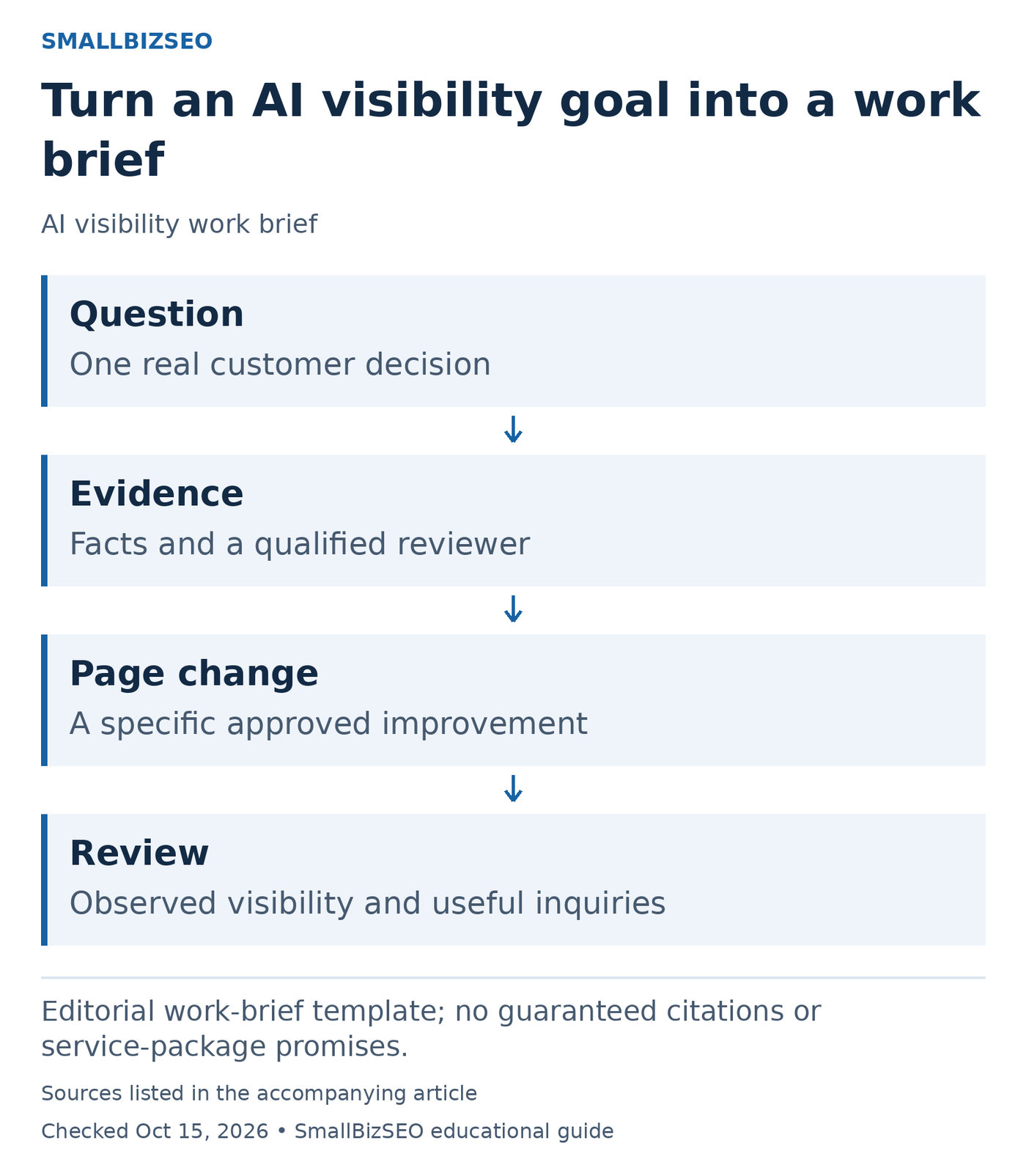
Editorial work-brief template; no guaranteed citations or service-package promises.
Sources: Google AI optimization guide. Checked October 15, 2026. This visual is an editorial guide, not measured client results.
Hypothetical example: A maintenance business repeatedly hears, “Should I repair or replace this equipment?” Its brief identifies an existing service page, adds a comparison of practical constraints, and asks a qualified employee to check the explanation. Any example costs or timeframes remain unpublished until the business can support them. The intended customer action is an assessment request, not an automatic replacement sale.
Ask the provider to distinguish the actual deliverable from the hoped-for result. “Revise the comparison and verify the page” is deliverable work. “Appear in every AI answer” is outside the provider’s control. Keep the agreed scope, approval owner, and review date beside the brief.
Google’s guidance favors distinctive, useful information rather than mechanical AI-specific rewrites. Use that principle to assess the proposed work, while checking other platforms against their own documentation. This worksheet is a planning aid and does not describe an included SmallBizSEO package.
Reference: Google AI optimization guide
Can SmallBizSEO guarantee AI mentions or citations?
Search and AI providers decide what to retrieve and display. A service can improve information quality, access, and measurement, but those actions do not guarantee a mention, citation, ranking, or lead. Ask for the work plan and the evidence used to judge progress rather than a promise of a particular answer.
How should results be measured?
For Google, current documentation includes a Generative AI performance report in Search Console. Website analytics and lead tracking can add business context. Other platforms may require different methods, and spot-checking a few prompts gives only a limited view.
Begin by choosing relevant customer questions and business outcomes. Then review your important pages using the Answer-Ready SEO resource and discuss which improvements belong in your SEO plan. Keep the focus on information your business is genuinely qualified to provide.