


Measure AI search in three layers: where your business or pages appear, which visits you can identify, and what useful actions those visitors take. These layers need different evidence. A mention is not a visit, and a visit is not automatically a qualified lead or sale.
What can I measure for Google AI search?
Google's Generative AI performance report in Search Console currently reports impressions for supported Search features, including AI Overviews and AI Mode. Its dimensions include pages, countries, dates, and devices. Google says the report may be absent when a site has not received enough relevant impressions.
As of this article's October 13, 2026 review, that dedicated report is an impressions report. Do not present its totals as dedicated AI click, lead, or revenue measurements. Check the current documentation as reporting capabilities change.
How can I assess visits and outcomes?
Review website analytics for identifiable referring sources and examine the landing pages and actions associated with them. Use a consistent source classification and document any changes to it. Google Analytics' traffic acquisition report provides a starting point for analyzing session sources and configured key events.
Some journeys may lack a clear referrer or involve several visits and channels. Treat identifiable AI referrals as an observable subset, rather than a complete census of everyone influenced by an AI answer. Customer feedback can add context, although self-reported discovery is imperfect too.
Are prompt checks useful?
They can help inspect whether an answer represents your business accurately or points to useful sources. Keep a small, relevant set of customer questions and record the date, platform, wording, and observed result. Results can change, so one successful response does not prove broad or lasting visibility.
For example, an owner could check whether a comparison question describes the company's service limitations correctly. That is an accuracy review, not an estimate of total market share.
What should an AI visibility report include?
The platforms and questions being assessed.
The data source and the exact meaning of each metric.
Relevant page-level visibility trends.
Identifiable visits and meaningful on-site actions.
Lead-quality or sales context where available.
Known gaps, assumptions, and changes in measurement.
Keep three separate evidence lanes
Build an AI-search review with three clearly labeled lanes. Do not join them into a single conversion funnel unless the underlying systems genuinely connect the same journeys.
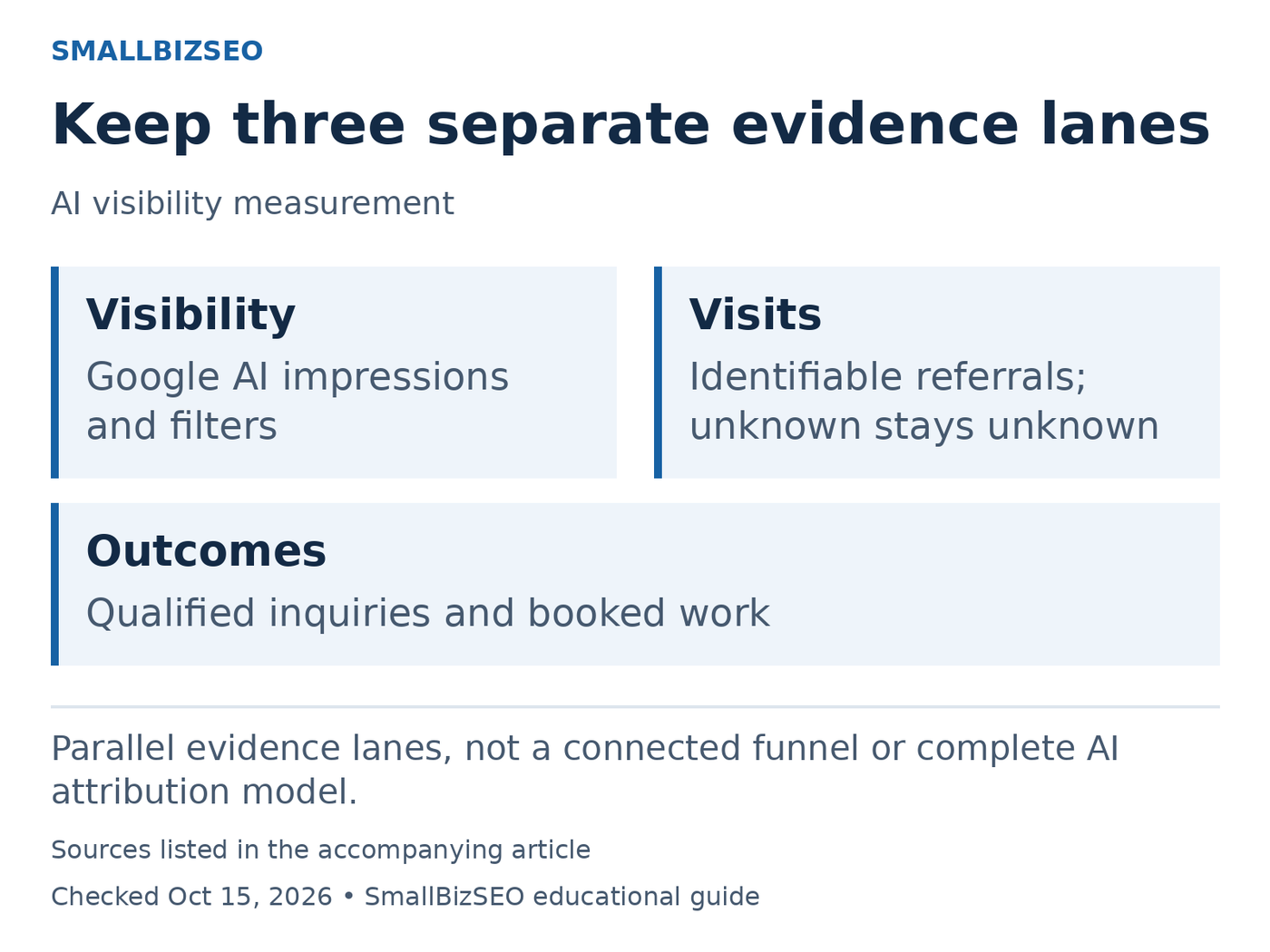
Parallel evidence lanes, not a connected funnel or complete AI attribution model.
Sources: Generative AI performance report; GA4 traffic acquisition. Checked October 15, 2026. This visual is an editorial guide, not measured client results.
Visibility lane: Export the relevant page and date view from Google’s Generative AI performance report. As checked October 15, 2026, the reported metric is impressions, not dedicated AI clicks or sales. Save the filters and note preliminary data. Keep page-level totals and property-level totals distinct because their aggregation can differ.
Visit lane: Inspect identifiable referral sessions and their landing pages in your analytics setup. Record the source rules used and flag changes to those rules. An unknown source stays unknown; do not redistribute it to AI simply because AI visibility increased.
Outcome lane: Review actual inquiries, qualification decisions, and booked work in customer records. Note any supported connection to a measured visit, and preserve uncertainty where the connection is missing. Ask customers how they found you when appropriate, but label that as self-reported context.
In the review, write one observation and one limitation for each lane. For example, increased page impressions alongside unchanged qualified inquiries suggests a question to investigate, not proof that AI traffic failed to convert. Keep prompt spot-checks in a separate accuracy log.
Reference: Generative AI performance report · GA4 traffic acquisition
What is a useful next step?
Choose the customer questions and pages that matter commercially, record a baseline, and improve their factual usefulness. Review visibility alongside visits and outcomes rather than celebrating isolated mentions. The goal is to learn which information helps potential customers discover and evaluate your business, while being honest about what the available reporting cannot establish.