


Choose an SEO package by matching the work you need to your business goals, website condition, competition, and ability to support the campaign. A larger package is useful when there is worthwhile additional work to do and enough capacity to do it well. Price or a longer feature list should not be the only deciding factor.
Choose an SEO package by fit
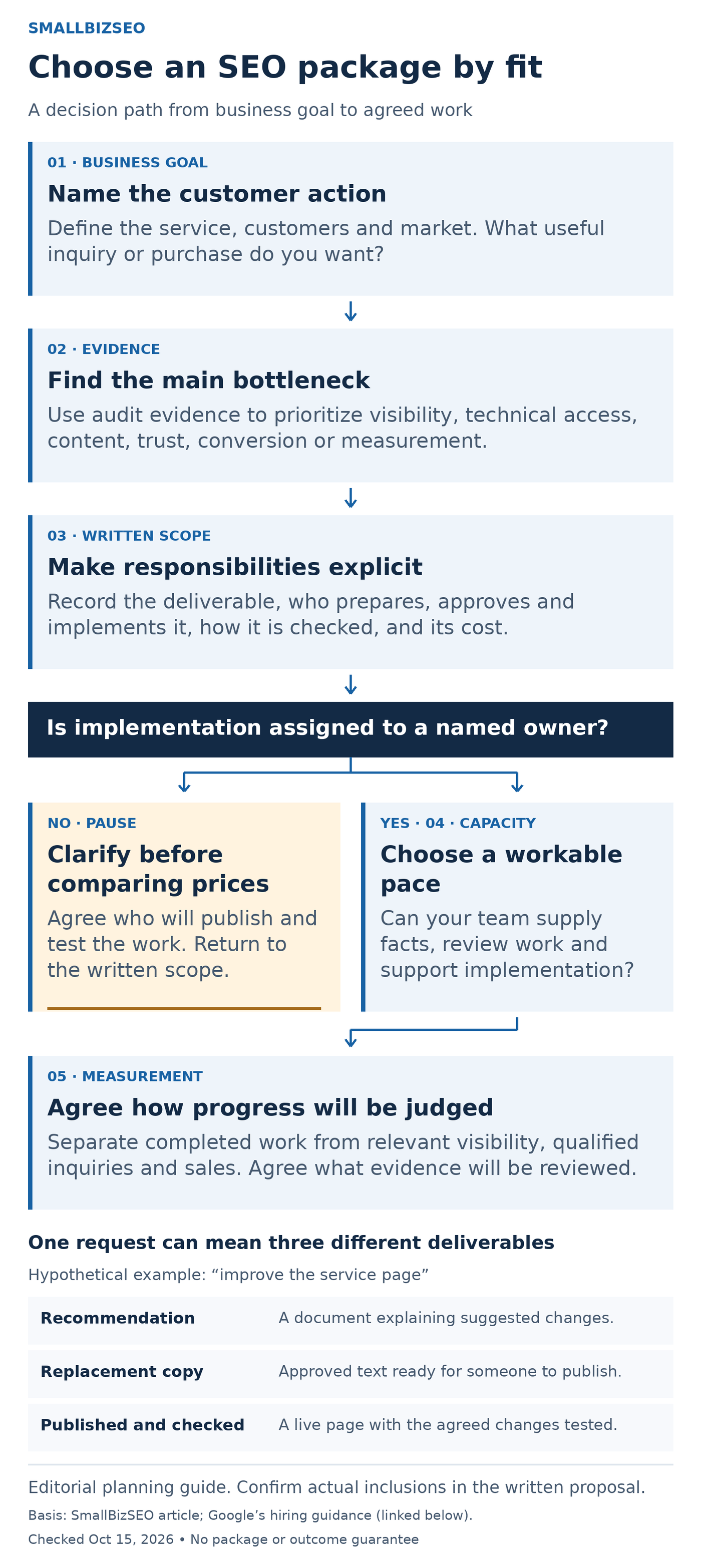
Choose scope that addresses an evidenced need and can be carried through. Editorial planning guide; confirm package inclusions and responsibilities in the written proposal.
SEO package decision guide: text version
Business goal: Define the service, customers and market, and the useful inquiry or purchase you want.
Evidence: Use audit evidence to identify the main bottleneck: visibility, technical access, content, trust, conversion or measurement.
Written scope: For each deliverable, record who prepares, approves and implements it, how completion is checked, and whether the cost is included or separately quoted. If implementation has no named owner, pause: agree who will publish and test the work before comparing prices, then return to the written scope.
Capacity: Once responsibilities are clear, choose a pace your team can support with business facts, review and implementation.
Measurement: Agree what evidence will be reviewed. Separate completed work from relevant visibility, qualified inquiries and sales.
Hypothetical service-page example: “Improve the service page” could mean a recommendation document, approved replacement copy ready for someone to publish, or a published page with the agreed changes tested. Ask which deliverable the proposal covers. These are examples, not SmallBizSEO package inclusions.
Source: SmallBizSEO editorial planning guide, checked October 15, 2026; informed by Google’s hiring guidance. Google supports questions about proposed changes, expected results, communication and measurement; it does not endorse this guide or any package.
Start with the customer action you want
Be specific about the business outcome. “More traffic” is less useful than more inquiries for a particular service, more qualified consultations, or more purchases from a defined product category. Include the customers and markets you can realistically serve.
For example, a consultant selling a specialized national service and a repair company covering a few nearby towns may need different page structures, evidence, and search opportunities. Neither business should choose a package simply because another company uses it.
Identify what is holding the website back
Before deciding how much ongoing work to buy, look for the main constraint:
Visibility: important services are missing from the website or difficult to find.
Technical access: useful pages cannot be crawled, indexed, or used reliably.
Content quality: pages leave important customer questions unanswered.
Trust: claims need better evidence, examples, or relevant recognition.
Conversion: visitors arrive but struggle to understand the offer or contact you.
Measurement: the business cannot tell which visits produce useful inquiries.
This is a planning checklist, not a diagnosis of your site. An audit should provide evidence for the priorities.
Compare scope and responsibility
SmallBizSEO presents Essential SEO, Scale SEO, and Dominance SEO on its SEO Packages page. Use those as starting points for a scope discussion. Ask how the proposed work applies to your website rather than assuming the package name establishes a particular outcome.
Turn the proposal into a responsibility checklist
Before choosing a package, ask each provider to complete the same checklist. For each activity, record the deliverable, who prepares it, who approves it, who implements it, how completion will be checked, and whether its cost is included or separately quoted. “Included” is not a complete answer if nobody owns implementation.
Use these six checklist items:
Existing-page improvements: Which URLs will change, what needs improving, and does the work include editing and publishing the changes?
New content: Which customer question will each page answer? Who supplies business facts and examples, reviews accuracy, handles revisions, and publishes the page?
Technical fixes: Is the deliverable a recommendation or an implemented change? Who can make the change on your platform, and who tests it afterward?
Business Profile or location work: Which eligible profiles or genuine locations are covered? Who supplies accurate business details and approves changes?
Links and publicity: What outreach or other work is proposed? Who approves claims and campaign materials? What will be reported if no placement is secured?
Measurement: Which inquiry or purchase actions will be tracked? Who tests them, reviews lead quality, and explains gaps in attribution?
Record dependencies and extra costs for each item. Examples include developer availability, access to a booking system, or photographs your business needs to supply. These are items to confirm, not a statement that any particular extra charge applies.
For example, “improve the service page” could mean delivering a document of suggestions, supplying approved replacement copy, or publishing and checking a finished page. Ask which outcome the proposal covers. This is a hypothetical comparison, not a description of a SmallBizSEO package.
If an important responsibility is unassigned, resolve it before comparing package prices. Use the current SEO Packages page for advertised options and the written proposal for your agreed responsibilities.
Questions to resolve before comparing SEO proposals. Planning checklist, not a package-inclusion table.
Source: SmallBizSEO editorial planning checklist, prepared October 14, 2026; informed by Google’s hiring guidance. Google supports asking about proposed changes, expected outcomes, communication and measurement; it does not endorse this particular checklist or any package.
Check your team's capacity
Your team may need to provide service details, examples, photographs, subject-matter review, or website access. A plan that produces work faster than you can review or implement it can create a backlog. Choose a pace the business can support while keeping information accurate.
Also consider what happens after a lead arrives. Availability, response time, pricing, and sales follow-up affect the value you receive from search visibility.
Agree on a useful way to assess progress
Ask what the initial work is intended to change and which evidence will show progress. Separate completed deliverables from outcomes such as relevant search visibility, qualified inquiries, and sales. Google's hiring guidance recommends asking providers about expected results, timeframes, communication, and how they measure success.
Bring your website, priority services, current concerns, and realistic budget to the conversation. The most useful recommendation explains why a particular scope fits your situation and what assumptions it depends on.