

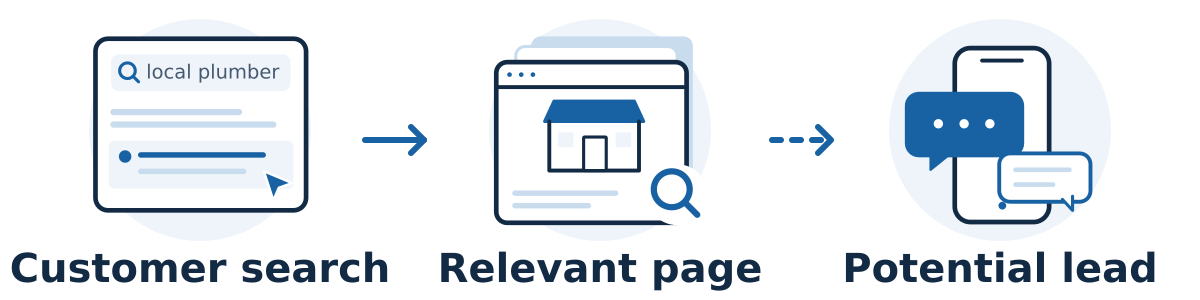
SEO stands for search engine optimization.
SEO is the process of improving your website and online presence so your business is easier to find in search engines like Google. When people search for products, services, or local businesses, SEO helps search engines understand what your business offers and when your website should appear.
For small businesses, SEO is usually focused on visibility in Google Search, Google Maps, and local search results. The goal is to help more potential customers find your business when they are already looking for what you offer.
Why SEO Matters for Small Businesses
Most customers search online before they call, visit, schedule, or buy.
If your business does not show up when people search for your services, you may lose potential customers to competitors who are easier to find. SEO helps improve your chances of appearing in front of people who are actively searching for businesses like yours.
SEO can help support more website visits, phone calls, form submissions, appointment requests, local customer interest, and trust with potential customers.
SEO is not only about getting traffic. It is about helping the right people find your business and take action.
How SEO Works
Search engines try to understand what each website is about, how useful the website is, and which search results are most relevant for each person’s search.
SEO helps improve the signals search engines use to understand your business.
This can include improving your website pages, page titles, headings, service descriptions, location information, Google Business Profile, reviews, business listings, internal links, website speed, mobile experience, and technical website setup.
When these pieces work together, search engines can better understand your business, your services, and the customers you are trying to reach.
Example
A plumbing company in Dallas may want to appear when people search for terms like “plumber near me,” “emergency plumber Dallas,” “water heater repair,” “drain cleaning service,” or “leak repair company.”
SEO helps make the plumbing company’s website, service pages, business information, reviews, and location signals clearer to search engines and potential customers.
The clearer and more useful the business appears online, the better chance it has of showing up for relevant searches over time.
SEO Is Not the Same as Paid Ads
SEO and paid ads both help businesses get found online, but they work differently.
Paid ads can place your business in sponsored positions when you pay for clicks or impressions. Once the ad budget stops, the ads usually stop showing.
SEO focuses on improving your organic visibility over time. Organic results are not paid placements. They are earned through stronger website content, better local signals, useful pages, technical improvements, and overall search relevance.
Many small businesses use both SEO and paid ads, but SEO is usually a longer-term strategy.
SEO Takes Time
SEO is not instant.
Search engines need time to discover changes, evaluate your website, compare your business to competitors, and update search results. Some improvements may happen quickly, while larger ranking, traffic, and lead improvements usually take longer.
Your SEO timeline can depend on your current website quality, competition, location, industry, Google Business Profile, reviews, content, technical setup, existing visibility, and how much SEO work is completed over time.
SEO works best as an ongoing process, not a one-time task.
What SEO Can Help Improve
SEO can help improve how your business appears online and how easily customers can find you.
A strong SEO strategy may help your business show up for more relevant searches, improve local visibility, make service pages clearer, help customers understand what you offer, improve website structure, fix common technical issues, support better search performance, build trust, and turn more visitors into leads.
SEO cannot guarantee exact rankings, exact traffic, or exact timelines, but it can help build a stronger foundation for long-term visibility.
Common SEO Mistakes
Many small businesses struggle with SEO because their website or online presence is unclear, incomplete, or inconsistent.
Common SEO mistakes include thin website content, unclear service descriptions, unnatural keyword use, incomplete Google Business Profile information, outdated business details, weak review activity, duplicate pages, slow website pages, poor mobile experience, and unrealistic expectations.
Good SEO focuses on clarity, usefulness, consistency, and trust.
What Makes SEO Successful
SEO works best when your website and online presence clearly answer important customer questions.
A strong small business SEO foundation usually includes a clear explanation of what your business does, accurate business information, helpful service pages, strong location signals, useful website content, a complete Google Business Profile, active reviews, a mobile-friendly website, clean technical setup, and consistent reporting.
The more clearly your business communicates what it offers and who it serves, the easier it becomes for search engines and customers to understand your value.
A plain-English map from search to customer
Think of SEO as a series of questions, rather than one switch that turns rankings on. A page can pass an early check and still fail to help the business. Use this map to describe a problem clearly when asking for help.
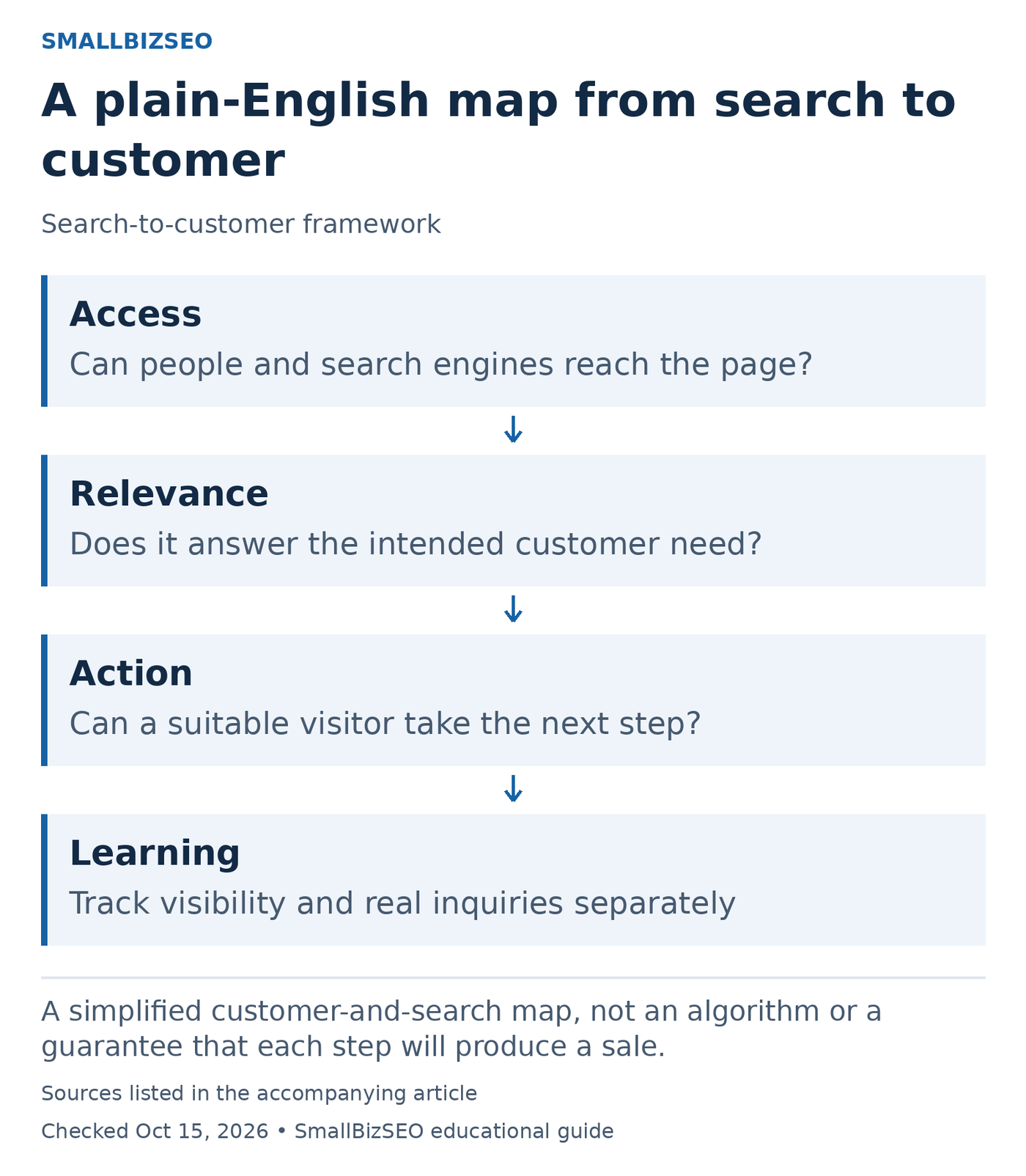
A simplified customer-and-search map, not an algorithm or a guarantee that each step will produce a sale.
Sources: Google official guidance. Checked October 15, 2026. This visual is an editorial guide, not measured client results.
Can the page be discovered and accessed? Check that an important service has a working public page and a route from the rest of the website. A broken address needs a different response from an unclear explanation. Google’s guide distinguishes helping search engines find content from making that content useful.
Does the page answer the right need? Read it as a prospective customer. Identify the service, who it suits, and the area or market covered. If those answers are missing, repeating a keyword is unlikely to solve the customer’s problem.
Can the visitor make a confident next move? Show accurate scope, relevant evidence, and a working contact or purchase route. For a hypothetical repair business, that could mean explaining which items it repairs and what information to include in an inquiry.
Can you learn what happened? Keep search visibility, website visits, and suitable inquiries separate. More people seeing a page does not prove more customers were won. Record one business goal and the evidence you will use to judge progress. This makes a conversation about SEO concrete without requiring you to learn every technical term.
Reference: Google’s official guidance. This checklist is an editorial planning aid; checked October 15, 2026.
When to Get Help With SEO
You may need SEO help if your business is not showing up for important searches, your website is not bringing in leads, your Google Business Profile is incomplete, or you are unsure how customers are finding you online.
You may also need help if you recently launched a new website, changed your business name, added a location, added services, moved addresses, or noticed a drop in traffic or leads.
SEO can be complex, but the goal is simple: help more of the right customers find your business online.
Need help understanding how SEO applies to your business? Contact the SmallBizSEO support team so we can review your account, package, and next recommended steps.